
Book Your Consultation Ready to experience authentic Himalayan Ayurveda? Contact Ayush Panchkarma to begin your personalized treatment journey. Located in Gopalpur, Palampur, Himachal Pradesh — in the pristine foothills of the Himalayas. Website: ayushpanchkarma.com | Email: doctor@ayushpanchkarma.com | WhatsApp: +91-8894356919
Mental health disorders have become a global health emergency. The World Health Organization reports that depression affects over 280 million people worldwide, making it the leading cause of disability, while anxiety disorders affect another 284 million. The COVID-19 pandemic triggered a 25% increase in anxiety and depression globally. While antidepressants and anxiolytics are widely prescribed, many patients find inadequate relief, unacceptable side effects, or wish to explore more holistic approaches. Ayurvedic treatment for anxiety and depression offers a profoundly integrative approach that addresses the mind, nervous system, digestive system, and lifestyle simultaneously.
Mental Health in Ayurveda: Manas Roga
Ayurveda has a sophisticated understanding of mental health through its branch of Manas Roga (diseases of the mind). Mental health, according to Ayurveda, depends on the balance of three mental qualities: Sattva (clarity, equanimity), Rajas (activity, desire), and Tamas (inertia, heaviness). Depression in Ayurveda correlates primarily with excess Tamas and depleted Sattva — creating the characteristic heaviness, low motivation, withdrawal, and hopelessness of clinical depression. Anxiety correlates with excess Rajas and aggravated Vata — creating the hyperactivity, racing thoughts, restlessness, and fear characteristic of anxiety disorders. Both conditions are seen in relationship to the gut-brain axis (Anna Shakti — digestive energy), sleep quality, and Ojas (vital essence) levels.
Panchkarma for Mental Health
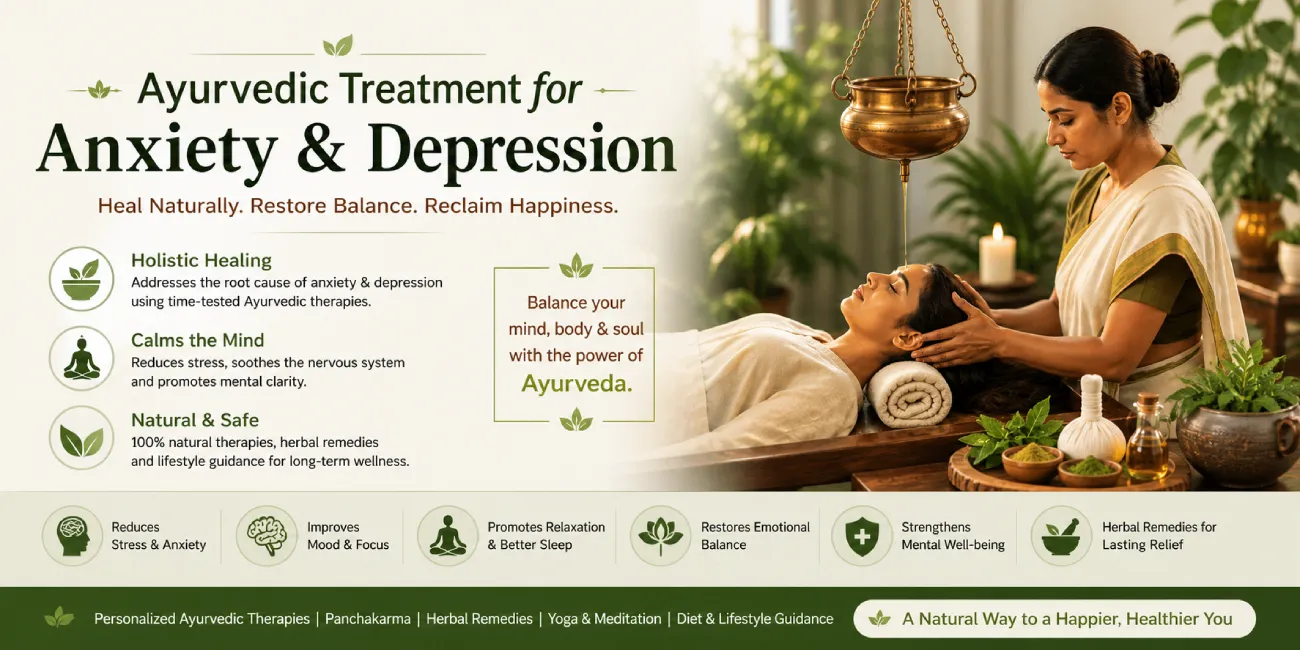
Shirodhara is without doubt the most powerful Ayurvedic therapy for anxiety and depression. The continuous stream of warm oil on the forehead activates the prefrontal cortex through skin-nerve-brain pathways, directly modulating the limbic system and hypothalamic-pituitary axis. Research has demonstrated that Shirodhara reduces cortisol, increases serotonin, reduces anxiety scores, and improves sleep quality — producing effects comparable to benzodiazepines without the dependency or cognitive impairment. Shirolepa (medicated paste application on head) with cooling herbs like Sandalwood, Brahmi, and Chandana provides immediate calming of Pitta-aggravated mental agitation. Abhyanga (full body oil massage) stimulates the parasympathetic nervous system, reduces cortisol, increases serotonin and dopamine, and provides the therapeutic benefit of mindful, compassionate physical touch. Basti (medicated enema) addresses the gut-brain axis — the bidirectional communication between the enteric and central nervous systems that is now recognized as fundamental to mental health. Nasya with Brahmi Ghrita or Anu Taila directly nourishes brain tissue through the olfactory pathway.
Herbal Medicines for Anxiety and Depression
Ashwagandha is the most researched Ayurvedic adaptogen for anxiety and depression. Multiple randomized controlled trials demonstrate its ability to reduce cortisol, anxiety scores (GAD-7), and depression symptoms. Its withanolides modulate GABA receptors (the target of benzodiazepines) and serotonin pathways. Brahmi (Bacopa monnieri) improves cognitive function, reduces anxiety, and protects neurons from stress-related damage. Jatamansi (Nardostachys jatamansi) is specifically indicated for depression and insomnia in Ayurvedic tradition — and modern research confirms its MAO-inhibiting properties. Shankhapushpi (Convolvulus prostratus) is a traditional nerve tonic with anxiolytic and nootropic properties. Saffron (Keshar) has multiple randomized trials demonstrating its antidepressant efficacy comparable to standard antidepressants, working through serotonin, dopamine, and GABA pathways.
Yoga and Meditation
Yoga, pranayama, and meditation are integral to Ayurvedic mental health treatment. Research consistently shows yoga and meditation reduce anxiety, depression, and PTSD while improving quality of life. Our program includes daily asana practice, pranayama (Anuloma-Viloma, Bhramari), yoga Nidra, and guided meditation. The Himalayan setting of Ayush Panchkarma — pristine nature, clean air, silence — is itself deeply therapeutic for urban-dwelling patients overwhelmed by noise, pollution, and constant stimulation.
Diet and Lifestyle for Mental Health
Ayurveda emphasizes Sattvic diet — fresh, light, nutritious, and mindfully prepared food — as the foundation of mental health. Avoiding Rajasic foods (excessively spicy, stimulant, and processed foods) and Tamasic foods (stale, fried, meat, and alcohol) is essential. Regular daily routine (Dinacharya) — consistent sleep times, morning routine, regular meals — is as important as any medicine for anxiety and depression, as Vata-driven mental disorders thrive in irregularity.