
📞 Book a consultation with our Ayurvedic specialists at Ayush Panchkarma — located in the heart of the Himalayas, Palampur, Himachal Pradesh. Website: ayushpanchkarma.com | Email: doctor@ayushpanchkarma.com
By Dr. Seema Santoshi, BAMS, CGO, YFC, PGDPSM, Chief Physician — Ayush Panchkarma, Palampur | Reviewed August 2026
Your doctor calls it a "silent killer" for a reason. High blood pressure rarely hurts. There's no obvious signal — just a number on a machine that keeps creeping upward, year after year, until it shows up as a heart attack, a stroke, or kidney failure. Most people spend decades on medication that controls the reading but never asks why the pressure was rising in the first place.
Ayurveda asks that question first.
At Ayush Panchakarma in Palampur, Himachal Pradesh, we treat hypertension not as a cardiovascular problem to be managed, but as a whole-body imbalance to be corrected. This article walks through exactly what that means — the Ayurvedic understanding of what causes BP to rise, which Panchakarma procedures bring it down at the root, and what lifestyle changes genuinely shift the pattern long-term.
What Ayurveda Says About the Real Cause of High Blood Pressure
Normal blood pressure is 120/80 mmHg. When systolic pressure stays above 130 or diastolic above 80 consistently, you're in hypertension territory. Modern medicine explains this through peripheral vascular resistance, cardiac output, and the renin-angiotensin system — accurate, but it doesn't tell you why those mechanisms went wrong in the first place.
Ayurveda maps the same phenomenon differently — and the difference is clinically meaningful.
The Dosha Behind Hypertension: Vata, Pitta, and Ama
In Ayurveda, the heart (Hridaya) is the seat of Prana — life force itself. Blood circulation is governed primarily by Vyana Vayu, a subtype of Vata responsible for the rhythmic, outward movement of blood through the body's channels (Srotas). When Vyana Vayu becomes disturbed — through chronic stress, irregular sleep, overwork, cold and dry food, excessive travel, or suppressed emotions — the normal pressure in the channels increases. That disturbance is the Ayurvedic root of hypertension.
Pitta aggravation adds another layer. Unprocessed anger, frustration, and resentment — emotions governed by Pitta — create mal-adaptation in the neuroendocrine system. The cortisol and adrenaline spike you get when Pitta goes out of balance maps almost directly onto what modern medicine calls "white-coat hypertension" or "stress-related BP elevation." People with a Pitta-Vata constitution are therefore significantly more prone to hypertension than any other type.
Ama — the metabolic residue left when Agni (digestive fire) is weak — makes the situation worse. Ama lodges in the Rasavaha and Raktavaha Srotas (plasma and blood channels), thickening them and creating what modern medicine would recognise as arterial stiffness and plaque. Digestion is not a side issue in hypertension — it is central to it.
In summary: the Ayurvedic cause of high blood pressure is disturbed Vyana Vayu + Pitta aggravation + Ama in the blood channels. All three must be addressed for lasting results.
Which Panchakarma Is Best for High Blood Pressure? Core Procedures Explained
Panchakarma is physician-supervised medical detoxification — not a spa programme. Our Panchakarma for hypertension protocols are built around clearing Ama from the blood channels, calming aggravated Vyana Vayu, and correcting Pitta-Vata imbalance. These are the procedures used:
See the full scope of our therapies on the Classic Ayurvedic Therapies page.
Why Shirodhara Is the Gold Standard for Hypertension
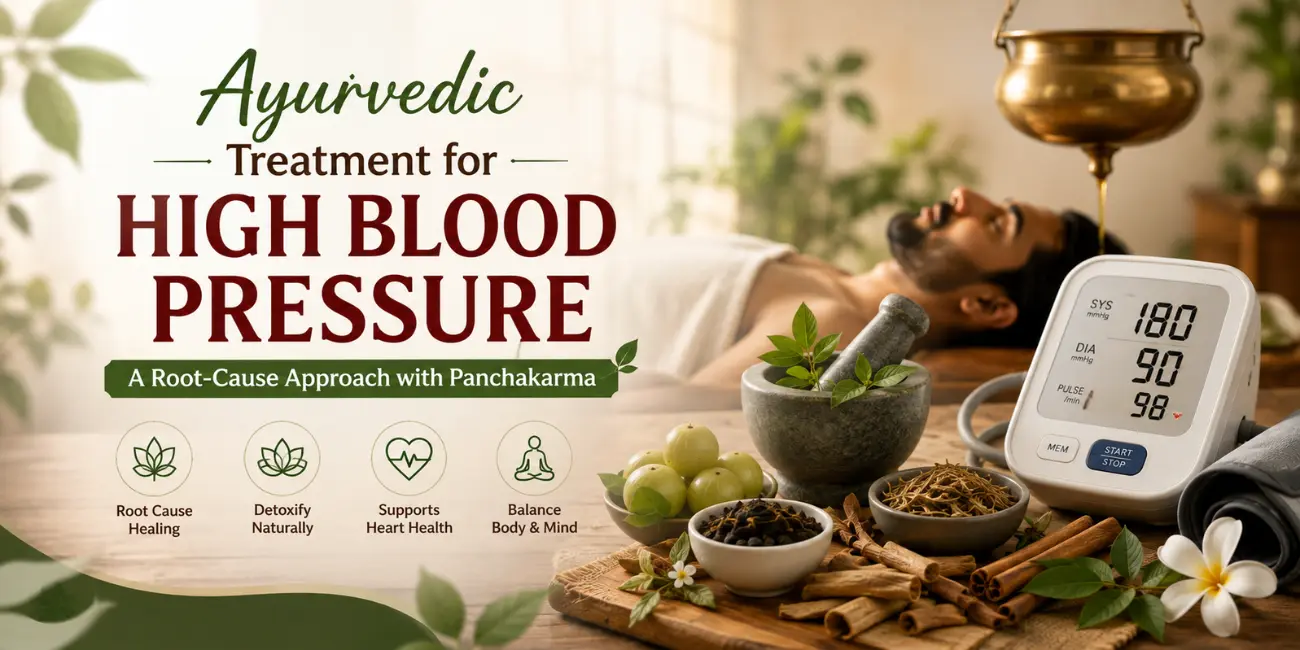
Shirodhara deserves special mention because its effect on blood pressure is both immediate and measurable. Warm medicated oil— is poured in a slow, continuous stream over the Agya Marma ( third eye ) point on the forehead for 30 to 45 minutes. The mechanical effect on the autonomic nervous system is profound: parasympathetic (rest-and-digest) tone increases, sympathetic (fight-or-flight) activation drops, cortisol falls, and BP readings typically come down within the session itself.
For patients whose hypertension is driven primarily by stress, irregular sleep, and a fast-paced life — which accounts for a majority of cases we see — Shirodhara is the most impactful single procedure in the programme.
Ayurvedic Herbs for High Blood Pressure: What Actually Works
Herb-infused oils (tailas) or liquids calm the central nervous system and regulate stress-induced hypertension. For high blood pressure, practitioners commonly formulate oils using Brahmi, Ashwagandha, Jatamansi etc which are absorbed through the scalp to lower cortisol and relax blood vessels. Commonly used herbs are :
Brahmi (Bacopa monnieri) — the primary nervine herb in Ayurveda; calms Vata, reduces cortisol-driven BP spikes, improves sleep quality. Used both internally and as the base for Shirodhara oil.
Ashwagandha (Withania somnifera) — adaptogen that directly modulates the stress response; reduces the adrenal activation that keeps BP chronically elevated.
Arjuna (Terminalia arjuna) — the most important heart-specific herb in Ayurveda; strengthens Hridaya (heart), supports healthy cardiac rhythm and arterial tone.
Sarpagandha (Rauvolfia serpentina) — one of the few Ayurvedic herbs with a modern pharmacological mechanism for hypertension; prescribed only by physician in appropriate cases.
Punarnava (Boerhavia diffusa) — primary herb for fluid retention and kidney-related BP components; a natural diuretic that doesn't deplete potassium.
Jatamansi (Nardostachys jatamansi) — deeply calming nervine; used when hypertension is accompanied by insomnia, anxiety, or palpitations.
Ayurvedic Diet for High Blood Pressure: Eat This, Not That
Diet is not a lifestyle footnote — in Ayurveda, it is treatment. For hypertension, the dietary goal is threefold: reduce Ama production, pacify Pitta and Vata, and strengthen Agni so the channels stay clear.
Eat More Of
Warm, freshly cooked meals eaten at consistent times — meal regularity itself stabilises Agni.
Mung dal, barley, old rice, and light lentil soups — the core of a hypertension-friendly Ayurvedic diet.
Bitter gourd, ridge gourd, and ash gourd — Pitta-reducing vegetables that support the liver and blood.
Garlic (raw, one clove daily) — classical Ayurvedic remedy for Ama in the blood channels; now well-supported by research for modest BP reduction.
Pomegranate and amla — two fruits with the strongest evidence base for cardiovascular benefit; Pitta-reducing, Rasayana in quality.
Coconut water and warm water through the day — keeps the Srotas hydrated without aggravating Kapha.
Coriander, cardamom, fennel, and cumin — Pitta-pacifying spices that also support digestion and Agni.
Avoid or Significantly Reduce
Excess salt (sodium) — the most direct dietary driver of fluid retention and BP; Ayurveda specifically names Lavana (salt) as a Pitta and Ama aggravator.
Spicy, sour, and fermented food — aggravates Pitta; keep chilli, pickle, vinegar, and alcohol minimal.
Red meat and heavy non-vegetarian food — Ama-forming, heavy to digest, increases Pitta in the blood.
Refined sugar, maida, and processed packaged food — poor digestibility means constant Ama production.
Cold drinks and ice — suppress Agni, increase Ama, aggravate Vata.
Caffeine — aggravates Vata and Pitta; raises heart rate and BP acutely.
Eating under stress or rushing meals — Ayurveda names this Krodha-bhojana (eating in anger/hurry) as a direct cause of Vyana Vayu disturbance.
Pranayama and Yoga for Hypertension: The Nervous System Reset
The connection between the nervous system and blood pressure is not subtle — it is the mechanism. Chronic sympathetic nervous system activation keeps vessels constricted and BP elevated. Pranayama is the most direct tool Ayurveda offers for shifting that balance.
Anulom Vilom (Alternate Nostril Breathing) — balances the two hemispheres of the autonomic nervous system; the single most broadly studied Pranayama for BP reduction. 10–15 minutes daily for 8 weeks produces measurable changes in both systolic and diastolic readings.
Bhramari (Humming Bee Breath) — the humming vibration activates the vagus nerve directly; proven parasympathetic activator; excellent for palpitation and anxiety-related BP spikes.
Sheetali (Cooling Breath) — draws cool air across the tongue; directly pacifies Pitta; particularly useful for hot-tempered, Pitta-dominant hypertension.
Dirgha Shwasa (Full Yogic Breath) — retrains shallow breathing patterns that chronically activate the stress response.
Yoga postures that specifically help: Shavasana (non-negotiable — it is not rest, it is practice), Paschimottanasana, Viparita Karani (legs up the wall), and gentle Supta Baddha Konasana. Inversions and intense Kapalbhati are avoided in hypertension until BP is under control.
Why Palampur, Himachal Pradesh Is an Ideal Place to Treat Hypertension
This is not a marketing line — it is clinical reasoning. The Panchakarma centre at Palampur sits in the Kangra Valley at approximately 1,200 metres above sea level, in the foothills of the Dhauladhar range. The environment itself is therapeutic for hypertension:
Clean mountain air with PM2.5 and PM10 levels a fraction of Indian city averages — air pollution is a documented, independent risk factor for hypertension and cardiovascular disease.
Ambient natural soundscape — birdsong, flowing water, forest — consistently measured to lower cortisol and blood pressure in environmental psychology research.
Cooler, less humid climate — pacifies Pitta, which is the dosha most prone to aggravation in hot urban summers.
No urban schedule pressure — the programme is residential, meaning there's no commute, no office, no news feed. For stress-related hypertension, the absence of those triggers alone shifts the baseline.
Ayurvedic texts specifically recommend mountainous, forest-adjacent environments for heart conditions. Desha — the therapeutic quality of place — is named in Charaka Samhita as a treatment variable equal in importance to herbs and procedures.
Nearest airport: Gaggal (Dharamsala Airport), ~30 minutes. Nearest major railway: Pathankot (Punjab) or Chandigarh. Learn about where you'll stay: Homestay & Accommodation in Palampur.
FAQs: Ayurvedic Treatment for High Blood Pressure
Can Ayurveda permanently cure high blood pressure?
Ayurveda aims for root-cause correction rather than symptom suppression. For many patients — especially those whose hypertension is lifestyle-driven and not yet severe — long-term remission with significantly reduced or eliminated medication dependence is achievable. This requires completing a proper Panchakarma course and maintaining the dietary and lifestyle protocol afterward. Results depend on how long BP has been elevated, constitution, co-conditions, and adherence.
Is Ayurvedic treatment safe alongside my BP medication?
In most cases, yes — our approach is designed to be complementary. We never advise stopping prescribed antihypertensives without your cardiologist's approval. As the body responds to Panchakarma and herbal treatment, many patients find their medication dose naturally reduces over time, monitored by both their physician and ours. We review your current medications at the initial consultation.
Which Panchakarma procedure is most effective for hypertension?
Shirodhara is the most consistently effective single procedure for stress-related hypertension — its direct effect on the autonomic nervous system produces measurable BP reduction within sessions. For Pitta-driven hypertension with anger and inflammation, Takradhara and Virechana are primary. For Vata-dominant cases with anxiety and irregular sleep, Basti and Abhyanga form the backbone. The actual combination is decided after your Prakriti-Vikriti assessment.
How long does the Ayurvedic BP treatment programme last?
Mild to moderate hypertension (Stage 1, mild lifestyle factors): 14 days
Moderate hypertension with stress, sleep issues, or early kidney involvement: 21 days
Severe or long-standing hypertension with cardiac or metabolic co-conditions: 30 days
Duration is confirmed after initial consultation.
What is the Ayurvedic diet for high blood pressure?
Reduce salt, spicy food, red meat, processed food, and caffeine. Eat warm, freshly cooked meals at consistent times. Include garlic, pomegranate, amla, bitter gourd, mung dal, and Pitta-cooling spices like coriander and fennel. Drink warm water through the day. Avoid eating under stress or in a hurry.
Is Ayurvedic BP treatment available near Dharamsala or Kangra?
Yes. Ayush Panchakarma is located in Gopalpur, Palampur, Kangra District — approximately 30 minutes from Dharamsala and Gaggal Airport. We are the closest dedicated residential Panchakarma centre to Dharamsala in Himachal Pradesh. Book a consultation online and our team will help with travel logistics.
Related Conditions We Treat Alongside Hypertension
Hypertension rarely arrives alone. On our Diseases We Treat page, you'll find the full list of conditions we address. Those most commonly seen alongside high BP:
Diabetes and pre-diabetes — metabolic syndrome (hypertension + diabetes + obesity) is treated as a unified Kapha-Pitta-Ama pattern.
Anxiety, insomnia, chronic stress — addressed through Shirodhara, Jatamansi, and Brahmi protocols on our
Thyroid disorders — hypothyroidism in particular raises BP; our Specialised Treatments include dedicated thyroid protocols.
Obesity and metabolic syndrome — see our Panchakarma Packages for weight and metabolic focus.
Chronic kidney disease — Punarnava and Basti protocols support kidney function alongside BP management.
Read more Ayurvedic health articles on the Ayush Panchakarma Blog. Explore our Retreats in Himachal Pradesh for a longer wellness immersion.
About this article: Written and reviewed by the practicing Ayurvedic physicians at Ayush Panchakarma, Palampur, Himachal Pradesh. Claims about Ayurvedic hypertension management reflect classical Charaka Samhita references and peer-reviewed clinical research. References to modern pharmacology (e.g., Sarpagandha, garlic) are drawn from indexed research. Last updated: June 2026.
Book Your Ayurvedic Blood Pressure Consultation in Palampur
Speak with our Ayurvedic physician about a personalised Panchakarma programme for hypertension — in the clean mountain air of the Kangra Valley, Himachal Pradesh.
Book Online: https://ayushpanchkarma.com/book-appointment
WhatsApp / Call: +91-8894356919
Email: doctor@ayushpanchkarma.com
Address: V.P.O. Gopalpur, Tehsil Palampur, District Kangra, Himachal Pradesh – 176061