
Book Your Consultation Ready to experience authentic Himalayan Ayurveda? Contact Ayush Panchkarma to begin your personalized treatment journey. Located in Gopalpur, Palampur, Himachal Pradesh — in the pristine foothills of the Himalayas. Website: ayushpanchkarma.com | Email: doctor@ayushpanchkarma.com | WhatsApp: +91-8894356919
Thyroid disorders affect an estimated 200 million people worldwide, with hypothyroidism (underactive thyroid) being the most prevalent. Women are five to eight times more likely than men to develop thyroid conditions, which cause wide-ranging symptoms including fatigue, weight gain, hair loss, cognitive impairment, mood disorders, and reproductive dysfunction. While thyroid hormone replacement therapy is effective for hypothyroidism, many patients continue to experience persistent symptoms on standard doses, and the medications do not address the autoimmune root cause (Hashimoto's thyroiditis, which accounts for 90% of hypothyroidism cases in developed countries). Ayurvedic treatment for thyroid disorders offers a uniquely effective approach — particularly for autoimmune thyroiditis — by addressing immune dysregulation, metabolic impairment, and hormonal imbalance simultaneously.
Thyroid Disorders in Ayurveda: Galaganda and Gandamala
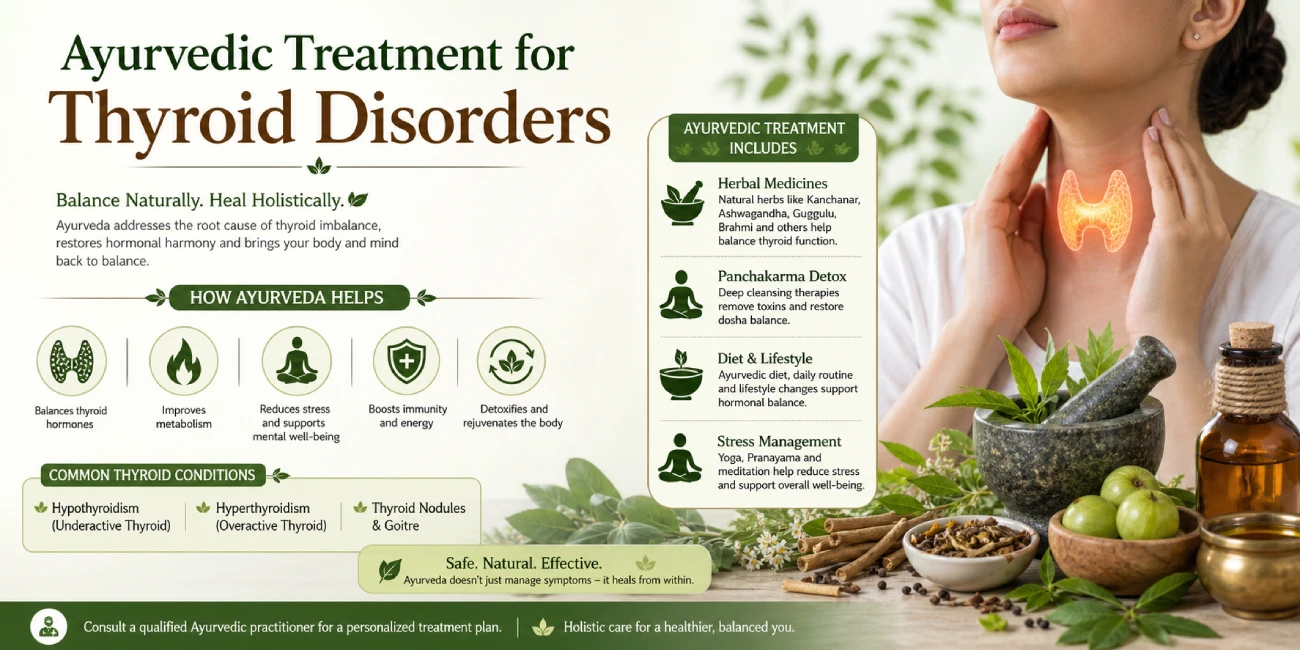
Classical Ayurvedic texts describe thyroid-related conditions under Galaganda (neck swelling involving Kapha and Vata) and Gandamala (lymph node-related neck enlargement). Modern correlation: Galaganda corresponds to goiter/hypothyroidism (Kapha-predominant enlargement with metabolic slowing), while Gandamala relates to lymphadenopathy and inflammatory thyroiditis. Ayurvedic thyroid management focuses on: correcting the underlying dosha imbalance (primarily Kapha and Vata in hypothyroidism; Pitta and Vata in hyperthyroidism); restoring Agni (thyroid hormone is Ayurveda's metabolic fire made material); reducing autoimmune Ama through immune correction; nourishing the thyroid gland and supporting iodine metabolism.
Panchkarma Therapies for Thyroid Disorders
For Hypothyroidism (Kapha-Vata type): Udwartana (stimulating dry massage) kindles metabolism and reduces Kapha stagnation. Virechana improves liver metabolism critical for thyroid hormone T4-to-T3 conversion. Nasya (particularly with Anu Taila or Vacha-based preparations) directly stimulates the hypothalamus-pituitary axis governing TSH secretion. Greeva Basti (oil bath around neck) directly nourishes thyroid tissue. For Hyperthyroidism/Hashimoto's (Pitta-Vata type): Shirodhara calms the nervous system activation and Pitta aggravation. Virechana purifies blood and reduces the inflammatory Pitta-Ama driving autoimmune attack. Takradhara with cooling buttermilk preparations manages the excess heat and anxiety of hyperthyroidism.
Herbal Medicines for Thyroid Disorders
Kanchanara (Bauhinia variegata): The most important Ayurvedic herb for thyroid gland health. Kanchanara has specific affinity for the thyroid and lymphatic system. Kanchanara Guggulu is the primary formulation for goiter and thyroid nodules. Guggulu: Its guggulsterones have documented thyroid-stimulating properties in hypothyroidism, increasing T3 and T4 levels. Ashwagandha: Multiple studies demonstrate its ability to improve thyroid hormone levels in hypothyroidism patients, likely through HPA axis modulation. Brahmi: Manages the anxiety, cognitive fog, and mood disorders accompanying both hypothyroidism and hyperthyroidism. Gokshura: Supports the kidney-adrenal-thyroid axis interconnection. Shilajit: Rich in fulvic acid and 80+ trace minerals including iodine, selenium, and zinc — all critical for optimal thyroid function.
Diet for Thyroid Health
For Hypothyroidism (avoid Kapha aggravating): Reduce raw cruciferous vegetables (goitrogens that block iodine uptake when eaten raw — cooking deactivates them); avoid soy products; increase iodine-rich foods (seaweed, seafood for non-vegetarians); selenium-rich foods (Brazil nuts, sunflower seeds); zinc-rich foods (pumpkin seeds, legumes). For Hyperthyroidism: Increase goitrogenic foods (raw cabbage, broccoli — naturally suppress excess thyroid activity); reduce stimulants (caffeine, alcohol); emphasize cooling, Pitta-pacifying foods.
Lifestyle and Yoga for Thyroid Health
Yoga offers specific benefits for thyroid health. Sarvangasana (shoulder stand) and Halasana (plow pose) directly stimulate the thyroid gland through compression and subsequent blood flow. Ustrasana and Matsyasana stretch the throat, improving circulation to the thyroid. Regular practice of these poses, combined with Pranayama (Ujjayi breath specifically for thyroid), supports thyroid function. Stress management is critical — chronic stress dysregulates the HPA-thyroid axis, a central mechanism in Hashimoto's disease development.