
Book Your Consultation Ready to experience authentic Himalayan Ayurveda? Contact Ayush Panchkarma to begin your personalized treatment journey. Located in Gopalpur, Palampur, Himachal Pradesh — in the pristine foothills of the Himalayas. Website: ayushpanchkarma.com | Email: doctor@ayushpanchkarma.com | WhatsApp: +91-8894356919
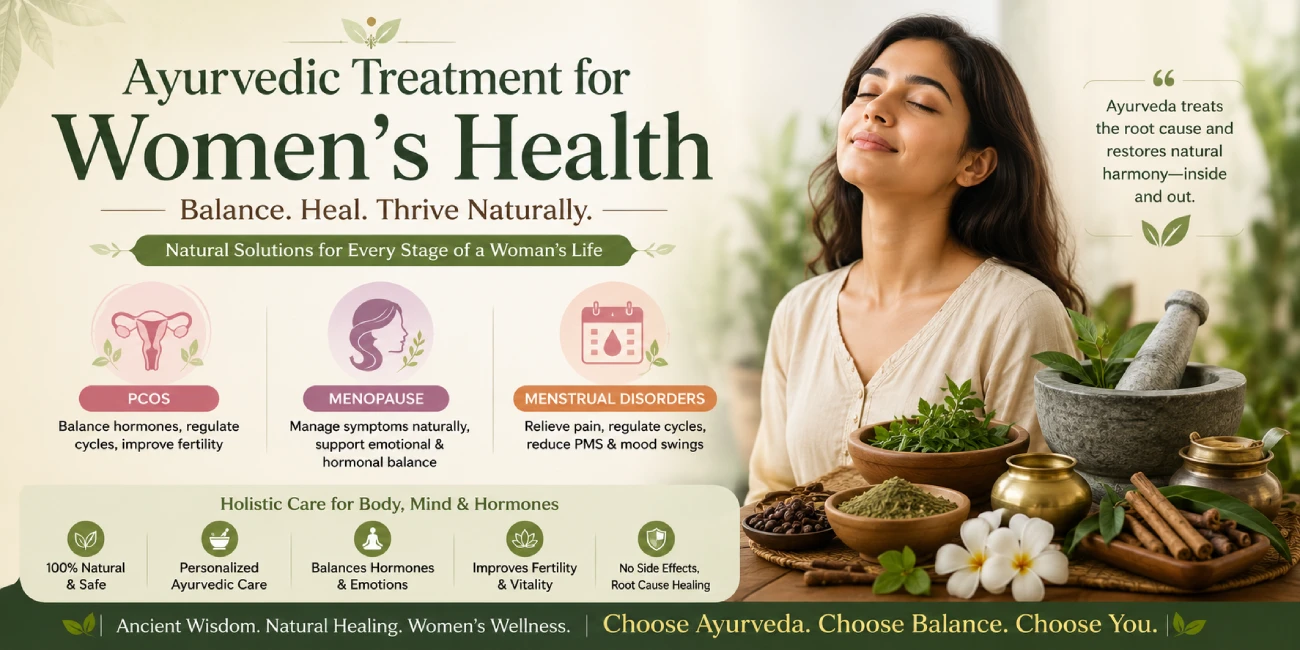
Women's health encompasses a unique spectrum of conditions across the reproductive lifespan — from menstrual disorders and PCOS in the reproductive years to perimenopause and postmenopause transitions, gynecological conditions like endometriosis and fibroids, and challenges of fertility. These conditions affect hundreds of millions of women globally and significantly impact quality of life, mental health, and reproductive outcomes. Ayurvedic Treatment for PCOS — through its specialized branch of Stri Roga (gynecology) — offers a deeply holistic, hormonal, and constitutional approach that addresses the fundamental endocrine, metabolic, and psycho-emotional dimensions of women's health at every life stage.
Women's Health in Ayurveda: Stri Roga and Artava Dhatu
Ayurveda devotes an entire specialized branch — Stri Roga (gynecology) and Prasuti Tantra (obstetrics) — to women's health, with classical texts providing detailed descriptions of menstrual physiology, gynecological disorders, pregnancy management, and postpartum care. The female reproductive system is governed by Apana Vata (downward-moving Vata) and Artava (menstrual fluid/reproductive tissue). The menstrual cycle is a monthly 'health barometer' in Ayurveda — its regularity, quality, and absence of discomfort reflect the overall balance of all three doshas and the health of reproductive tissues (Artava Dhatu).
PCOS: Ayurvedic Understanding and Treatment
PCOS (Polycystic Ovarian Syndrome) — characterized by irregular menstruation, androgen excess, and polycystic ovaries — is among the most common endocrine disorders in women of reproductive age, affecting 8-13% globally. In Ayurveda, PCOS corresponds primarily to a Kapha-Vata disorder: Kapha accumulation impairs follicular development and ovulation; insulin resistance (Meda dhatu excess) amplifies androgen production; Vata irregularity disrupts ovulatory timing. Our PCOS protocol combines: Virechana to reduce excess Pitta and hepatic androgen load; Udwartana for insulin resistance and weight management; Uttara Basti to directly stimulate ovarian and uterine function; herbs including Lodhra (normalizes LH/FSH ratio), Shatapushpa (fennel — promotes ovulation), Ashoka (uterine tonic), Trikatu (improves metabolism and insulin sensitivity), and Haridra (anti-androgenic through 5-alpha reductase inhibition).
Menstrual Disorders: Dysmenorrhea, Amenorrhea, Menorrhagia
Painful menstruation (Kasht-artava / Krichhra-artava) is primarily a Vata-Pitta disorder causing spasmodic uterine contractions and pelvic inflammation. Uttara Basti, Kati Basti, and Yoni Pichu (vaginal oil application) directly relax uterine smooth muscle and reduce menstrual pain. Herbs like Dashmool, Shatavari, and Ashoka significantly reduce dysmenorrhea. Irregular or absent menstruation (Artava Kshaya / Nashta-artava) involves Vata excess — often stress-related, post-pill, or related to PCOS. Basti therapy, hormone-balancing herbs (Shatavari, Ashoka, Lodhra), and lifestyle normalization restore menstrual regularity. Heavy menstrual bleeding (Rakta Pradara) involves Pitta vitiation — Virechana, blood-building herbs (Ashoka, Lodhra, Nagkesar), and specific dietary interventions reduce excessive bleeding.
Menopause: Ayurvedic Management of the Transition
Menopause is a natural life transition in Ayurveda — not a disease requiring treatment. However, its symptomatic manifestations — hot flashes, insomnia, mood changes, vaginal dryness, bone loss — can be significantly managed. Menopause in Ayurveda primarily involves Vata increase (as Pitta and Kapha naturally decrease with age) combined with Pitta-mediated hot flashes. Shirodhara addresses hot flashes, insomnia, and mood swings. Abhyanga counters Vata-driven dryness and joint pain. Shatavari is the most important herb for menopause — its phytoestrogens reduce hot flashes, support vaginal health, and protect bone density. Ashwagandha manages stress and adrenal support critical in postmenopausal hormonal regulation. Brahmi supports cognitive function and mood in menopause.
Endometriosis and Fibroids
Endometriosis (Granthi in Ayurveda) involves Vata-Kapha-aggravated Artava depositing outside the uterus, triggering inflammatory reactions. Our protocol combines Virechana (reduces Pitta-mediated inflammation), Uttara Basti (clears displaced endometrial tissue through local action), and herbs like Kanchanara (reduces glandular overgrowth), Shallaki (anti-inflammatory), and Guggulu (immunomodulatory and anti-Kapha). Uterine fibroids similarly respond to Kanchanara Guggulu, Triphala, and specific Uttara Basti protocols, with many patients experiencing meaningful fibroid size reduction over 6-12 months of treatment.