
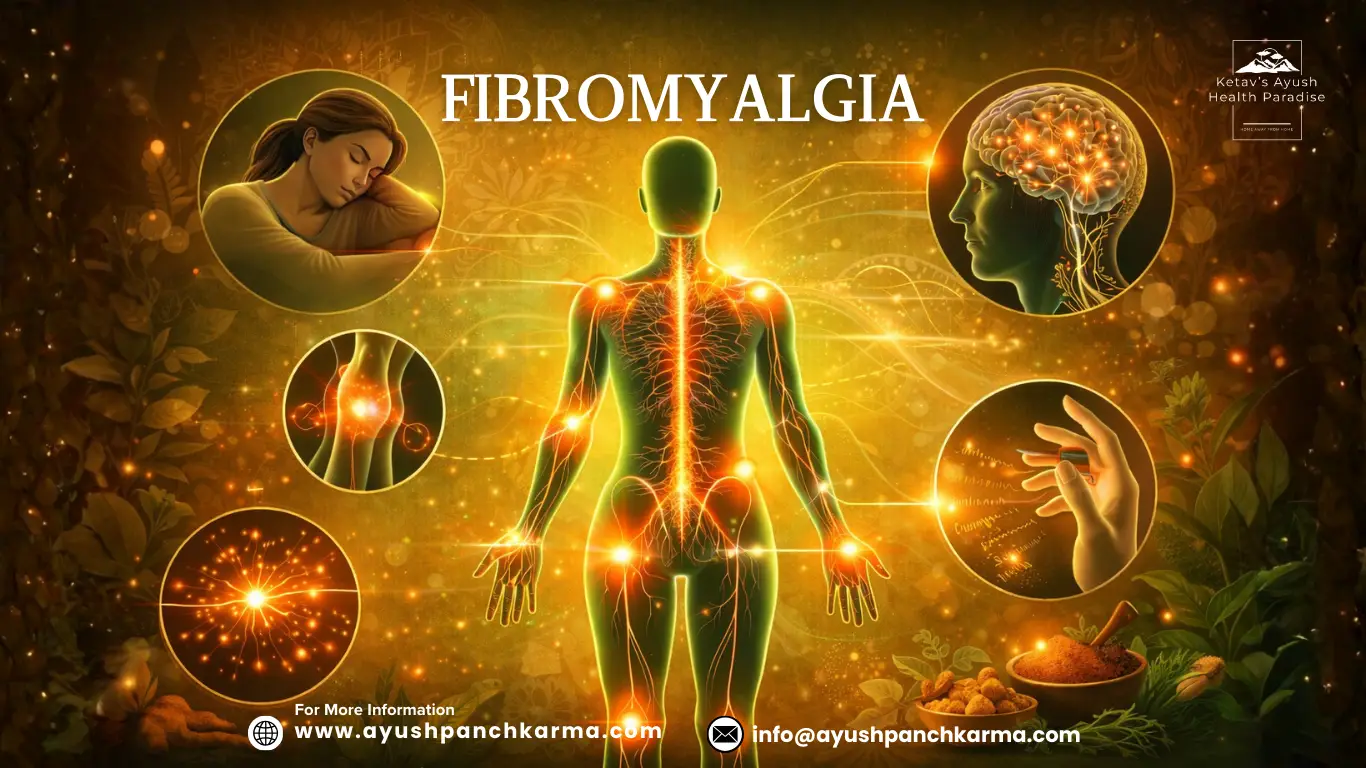
What is fibromyalgia …..? Fibromyalgia is a chronic condition affect muscles and soft tissue, characterized wide spread pain and tenseness in the body along with fatigue. Fibromyalgia make the person hypersensitive towards the sense of pain. In fibromyalgia patients have been found to have lower levels of a brain neurotransmitter called serotonin, which leads to lowered pain thresholds and increased sensitivity to pain and serotonin promotes a calm and stable mental state also.
What Is Fibromyalgia? — Overview
Fibromyalgia (also called Fibromyalgia Syndrome or FMS) is a chronic, long-term pain condition characterised by widespread musculoskeletal pain, fatigue, sleep disturbances, and cognitive difficulties — often described as 'fibro fog.' Unlike arthritis or inflammatory disorders, fibromyalgia does not cause visible tissue inflammation, joint deformity, or damage to internal organs.
Fibromyalgia progresses slowly over time, and because its symptoms overlap with many other conditions, it remains one of the most underdiagnosed and misunderstood chronic pain disorders worldwide. It was formerly known as fibrositis, and is now recognised as a centralised pain processing disorder — meaning the brain and nervous system amplify pain signals abnormally.
🔑 Key Fact Fibromyalgia affects an estimated 2–4% of the global population and is significantly more common in women. It can occur at any age but is most frequently diagnosed between the ages of 30 and 60. |
Causes of Fibromyalgia — What Triggers It?
The exact cause of fibromyalgia is not fully understood. Current research points to a phenomenon called central sensitisation — where the brain and spinal cord process pain signals in a heightened, amplified manner. Several contributing factors have been identified:
1. Central Sensitisation & Neurological Factors
The brain lowers the pain threshold and the nervous system becomes hypersensitive to stimuli. Nerve receptors overreact to pain signals, generating exaggerated or false pain responses even in the absence of injury or inflammation.
2. Genetics and Family History
Fibromyalgia tends to run in families. Specific genetic mutations affecting neurotransmitters — particularly serotonin, dopamine, and norepinephrine — may predispose individuals to developing the condition. If a first-degree relative has fibromyalgia, your risk is significantly higher.
3. Physical or Emotional Trauma
A significant physical injury (such as a car accident or surgery) or severe psychological trauma can trigger fibromyalgia. Post-Traumatic Stress Disorder (PTSD) is strongly associated with fibromyalgia onset, particularly in women.
4. Chronic Illness and Infections
Certain long-term illnesses — including rheumatoid arthritis, lupus, osteoarthritis, and viral infections — can trigger fibromyalgia or significantly worsen its symptoms. Some researchers believe specific infections may act as a catalyst in genetically predisposed individuals.
5. Hormonal Imbalance and Chronic Stress
Prolonged psychological or physiological stress disrupts the hypothalamic-pituitary-adrenal (HPA) axis, leading to hormonal imbalances — particularly in cortisol and serotonin — that are closely linked to chronic widespread pain and fatigue.
6. Sleep Disorders
Disrupted sleep — especially the absence of restorative deep (delta-wave) sleep — is both a symptom and a contributing cause of fibromyalgia. Sleep deprivation heightens pain sensitivity and perpetuates the fibromyalgia cycle.
Fibromyalgia Symptoms — A Complete List
Fibromyalgia presents with a wide, overlapping constellation of symptoms that can vary in intensity from day to day. The most common fibromyalgia symptoms include:
Primary Symptoms
- Chronic widespread musculoskeletal pain — the hallmark symptom; aching, burning, or stabbing pain affecting multiple body areas simultaneously
- Persistent fatigue and exhaustion — even after adequate rest or sleep
- Fibro fog — cognitive difficulties including poor concentration, memory lapses, and mental confusion
- Non-restorative sleep — sleeping for long periods without feeling refreshed
- Tenderness at specific trigger points (tender points) across the body
Secondary and Associated Symptoms
- Chronic headaches and migraines
- Anxiety and depression — present in up to 30–50% of fibromyalgia patients
- Irritable Bowel Syndrome (IBS) — bloating, abdominal pain, alternating constipation and diarrhoea
- Temporomandibular joint (TMJ) disorders
- Numbness and tingling in the hands and feet (paraesthesia)
- Sensitivity to bright lights, loud noises, temperature changes, and strong odours
- Restless Leg Syndrome (RLS)
- Dry eyes and dry mouth
- Pelvic pain and bladder symptoms (interstitial cystitis)
- Dizziness and balance problems
⚠️ Important Fibromyalgia symptoms fluctuate — some days are better than others. This variability often leads to delayed diagnosis. Keeping a symptom diary is strongly recommended. |
How Is Fibromyalgia Diagnosed?
There is no single definitive test for fibromyalgia. Diagnosis is clinical — based on patient history, physical examination, and exclusion of other conditions. Fibromyalgia overlaps with many disorders, making diagnosis challenging and often delayed by years.
Diagnostic Criteria (ACR 2010 Guidelines)
According to the American College of Rheumatology (ACR), fibromyalgia is diagnosed when:
- Widespread pain index (WPI) score ≥ 7 and symptom severity (SS) score ≥ 5, OR WPI 3–6 and SS ≥ 9
- Symptoms have been present at a similar level for at least 3 months
- No other disorder adequately explains the pain
The 18 Tender Points (Classic Diagnostic Tool)
The older 1990 ACR criteria required the presence of at least 11 of 18 specific tender points (trigger points), located symmetrically on both sides of the body:
- Low cervical region (front of the neck, lower vertebrae)
- Front chest — below the collarbone, approximately 2 inches from the shoulder joint
- Inner elbow — inside the arm crease
- Inner knee — where the fat pads are located
- Base of skull — back of the neck
- Upper trapezius — where the trapezius muscle drapes over the shoulder
- Top of the shoulder blade (supraspinatus)
- Upper outer buttocks (gluteal region)
- Rear hip — greater trochanter region
Conditions to Rule Out Before Diagnosis
| Conditions to Exclude | Conditions to Exclude |
| Rheumatoid Arthritis | Polymyalgia Rheumatica |
| Lupus (SLE) | Vitamin D / B12 deficiency |
| Hypothyroidism | Ankylosing Spondylitis |
| Chronic Fatigue Syndrome (CFS/ME) | Autoimmune disorders |
| Spinal disorders (disc disease) | Sleep apnoea |
| Multiple Sclerosis | Lyme disease |
What Ayurveda Says About Fibromyalgia
In Ayurvedic medicine, fibromyalgia is best correlated with Mamsa-Medo Dhatugata Vata — a condition in which the aggravated Vata dosha becomes lodged in the muscle tissue (Mamsa dhatu), tendons, and adipose tissue (Meda dhatu), producing a cascade of characteristic symptoms.
It also falls under the broader category of Vatavyadhi — diseases of chronic, unpredictable nature caused primarily by Vata vitiation. Vatavyadhi primarily affects the musculoskeletal and nervous systems and, over time, draws Pitta and Kapha doshas as well as other Dhatus (body tissues) out of balance.
The Ancient Ayurvedic Perspective on Vata
"Pittam pangu kapham pangu pangavo mala dhatavaha | Vayushch yetra niyante tatra gacchati maghavat"
— Sharngdhasamhita
Translation: Pitta, Kapha, the Dhatus (tissues), and Malas (metabolic wastes) are all immobile ('lame') without Vata. They move only in the direction that Vata guides them. When Vata is imbalanced, every other system in the body is automatically destabilised.
Mamsa-Medo Dhatugata Vata — The Pathogenesis
Muscle tissue (Mamsa) and fat tissue (Meda) share similar qualities: Snigdha (unctuous), Guru (heavy), and Sthira (stable). These qualities are directly opposed to Vata's qualities of Ruksha (dry), Laghu (light), and Chala (mobile). When Vata becomes excessively aggravated, it penetrates and vitiates these tissues, producing fibromyalgia-like symptoms.
"Guru anga — Tudyate atyartham — Danda musti hatam — Shramika atyartham"
— Charaka Chikitsa Sthana
Symptom Correlation: Fibromyalgia ↔ Ayurveda
| Modern Fibromyalgia Symptom | Ayurvedic Equivalent (Lakshana) |
| Chronic widespread pain | Atyartha Toda (excess pain) |
| Fatigue & exhaustion | Atyartha Shrama (excessive exhaustion) |
| Muscle heaviness | Gauravam (heaviness of body) |
| Severe piercing pain | Danda Mushti Hatam (pain as if beaten with sticks) |
| Cognitive fog / confusion | Delusion / mental disturbance (Manobhrama) |
| Stiffness & contracture | Stambha (stiffness) |
| Sensory hypersensitivity | Depletion of sensory functions |
| Depression & anxiety | Mano Vikara (mental imbalance) |
Fibromyalgia Tender Points & Marma Vital Points
One of Ayurveda's most remarkable contributions to fibromyalgia understanding is the correlation between fibromyalgia's 18 tender points and Marma points — the 107 vital energy junctions described in classical Ayurvedic texts. Marma points are anatomical sites where muscles, vessels, bones, ligaments, tendons, and joints converge. Injury or imbalance at these points can cause significant systemic effects.
Tender Point to Marma Point Mapping
| Fibromyalgia Tender Point Location | Corresponding Marma Point |
| Low cervical region | Neela Marma |
| Front chest (2" below collarbone, shoulder junction) | Apastambha Marma |
| Inner elbow (arm crease) | Kurpara Marma |
| Inner knee (fat pad area) | Ani Marma |
| Base of skull (back of neck) | Krikatika Marma |
| Upper trapezius (top of shoulder) | Amsa Marma |
| Top of shoulder blade | Amsaphalka Marma |
| Upper outer buttock | Katika Tarunam Marma |
| Rear hip | Nitamba Marma |
Therapies targeting these Marma points — including Marma chikitsa (Marma therapy), specific Abhyanga strokes, and Kizhi (herbal poultice treatment) — form an essential component of Ayurvedic fibromyalgia management.
Ayurvedic Treatment for Fibromyalgia — Our Approach
Modern medicine currently has no cure for fibromyalgia. Conventional management focuses on symptom suppression using antidepressants, anticonvulsants, and pain relievers — which often carry significant side effects and do not address the root cause.
At Ketav's Ayush Health Paradise, our Classical Ayurvedic Panchakarma approach addresses fibromyalgia at its root — balancing the aggravated Vata dosha, clearing metabolic toxins (Ama), and rebuilding tissue integrity — making day-to-day life more comfortable and preventing further progression.
Our Three-Pillar Treatment Objective
- Dosha Balance — achieving equilibrium of Vata, Pitta, and Kapha at both physical and mental levels
- Detoxification (Shodhana) — eliminating Ama (toxins) and stopping disease progression
- Rejuvenation (Rasayana) — rebuilding tissues and improving quality of life
Key Ayurvedic Therapies for Fibromyalgia
1. Abhyanga (Full-Body Medicated Oil Massage)
Warm medicated oils — typically Mahanarayan Taila, Dhanwantharam Taila, or Bala Taila — are used in rhythmic, deep tissue massage. Abhyanga pacifies Vata, lubricates the musculoskeletal system, nourishes depleted tissues, reduces pain and stiffness, and promotes deep, restorative sleep.
2. Swedana (Herbal Steam Therapy)
Following Abhyanga, herbal steam therapy opens the channels (Srotas), loosens accumulated Ama, and allows deeper penetration of medicated oils into the tissues. It is particularly effective for relieving morning stiffness, joint pain, and muscle tightness in fibromyalgia.
3. Basti (Medicated Enema — The King of Vata Therapies)
Basti is considered the most powerful treatment for Vata disorders in Ayurveda. A series of medicated oil and decoction enemas directly pacify Vata in the colon — the primary seat of Vata — and have far-reaching effects on the musculoskeletal and nervous systems. Basti significantly reduces chronic pain, fatigue, and cognitive symptoms.
4. Virechana (Therapeutic Purgation)
When Pitta is also involved alongside Vata, Virechana is used to flush excess Pitta and Ama from the liver and gut, reducing systemic inflammation and supporting pain reduction.
5. Kizhi (Herbal Poultice Therapy)
Warm poultices filled with medicated herbs, rice, or sand are applied with rhythmic strokes to the body. Navarakizhi (rice poultice) is especially effective for nourishing depleted Mamsa and Meda dhatu, reducing pain, and improving muscle strength and flexibility.
6. Shirodhara (Continuous Oil Streaming to the Forehead)
A continuous, steady stream of warm medicated oil poured over the forehead profoundly calms the nervous system, reduces anxiety and depression, improves sleep quality, and alleviates fibro fog — addressing the neurological root of fibromyalgia.
7. Marma Chikitsa (Vital Point Therapy)
Targeted stimulation of the 9 Marma points corresponding to fibromyalgia tender points helps release energy blockages, reduce local tenderness, and restore smooth Vata flow through the body's channels.
8. Rasayana (Rejuvenation Therapy)
Following Panchakarma detoxification, Rasayana therapies are prescribed to rebuild damaged Mamsa and Meda dhatu, restore immunity (Ojas), improve energy, and prevent relapse. Classical formulations such as Ashwagandha Rasayana, Chyawanprash, and Bala Rasayana are commonly prescribed.
Best Ayurvedic Herbs for Fibromyalgia Relief
| Herb (Botanical Name) | Key Benefit for Fibromyalgia |
| Ashwagandha (Withania somnifera) | Reduces pain, fatigue & anxiety; rebuilds tissue |
| Guduchi / Giloy (Tinospora cordifolia) | Powerful adaptogen; reduces inflammation & boosts immunity |
| Bala (Sida cordifolia) | Nourishes Mamsa dhatu; reduces pain & weakness |
| Shatavari (Asparagus racemosus) | Balances hormones; reduces fatigue & sleep issues |
| Nirgundi (Vitex negundo) | Potent anti-inflammatory; relieves muscle spasm & pain |
| Formulation | Key Benefit for Fibromyalgia |
| Dashamoola (Ten Root Formula) | Vata-pacifying decoction; reduces widespread pain & stiffness |
| Mahanarayan Taila (External) | Medicated massage oil; alleviates musculoskeletal pain |
| Yogaraj Guggulu | Classical formulation for chronic Vata disorders |
| Rasna (Pluchea lanceolata) | Anti-inflammatory; reduces joint & muscle pain |
⚕️ Note: All herbal formulations should be prescribed by a qualified Ayurvedic physician based on individual constitution (Prakriti) and disease stage. Never self-medicate.
Ayurvedic Diet & Lifestyle for Fibromyalgia
Diet (Ahara) and lifestyle (Vihara) are considered medicine in Ayurveda. A Vata-pacifying diet combined with mindful daily routines can significantly reduce fibromyalgia symptom frequency and intensity.
✅ Recommended Foods (Vata-Pacifying Diet)
- Warm, freshly cooked, well-oiled foods — soups, kitchari, rice porridge
- Sweet, sour, and salty tastes — these balance Vata naturally
- Root vegetables — sweet potato, carrot, beet, yam
- Healthy fats — ghee, sesame oil, coconut oil
- Warm milk with turmeric and ashwagandha at bedtime — promotes sleep
- Soaked nuts and seeds — almonds, sesame, sunflower seeds
- Warming spices — ginger, cumin, coriander, fenugreek, ajwain
❌ Foods to Avoid (Vata-Aggravating)
- Cold, raw, and dry foods — salads, crackers, dry cereals, raw vegetables
- Processed and packaged foods
- Caffeine and alcohol — disrupt sleep and aggravate Vata
- Carbonated drinks — increase gas and Vata
- Nightshade vegetables — tomatoes, peppers, eggplant (in excess)
- Skipping meals or irregular eating times
Lifestyle Recommendations for Fibromyalgia
- Follow a consistent daily routine (Dinacharya) — regular sleep, meal, and exercise times are especially important for Vata
- Practise yoga, meditation, and pranayama daily — Yoga Nidra and Yin Yoga are particularly beneficial
- Gentle exercise — swimming, walking, tai chi; avoid overexertion
- Keep painful areas warm — use warm compresses, heating pads, and warm baths
- Prioritise restorative sleep — 7–9 hours; maintain consistent sleep-wake times
- Take recommended herbal supplements regularly and consistently
- Avoid exposure to cold, wind, and dramatic seasonal temperature changes
- Stay well hydrated — warm water throughout the day prevents constipation (a Vata imbalance)
- Engage in joyful, creative, and social activities — mental bliss (Sattva) is as healing as physical therapies
Frequently Asked Questions About Fibromyalgia
Q1. Is fibromyalgia a real disease or is it psychological?
Fibromyalgia is a genuine, recognised medical condition — not imagined or purely psychological. It is classified by the WHO (ICD-11) as a chronic pain disorder. Research using functional MRI has demonstrated measurable differences in pain processing pathways in fibromyalgia patients' brains.
Q2. Can Ayurveda cure fibromyalgia permanently?
While no system of medicine currently claims a permanent cure for fibromyalgia, Classical Ayurvedic Panchakarma treatment — when consistently followed — can achieve significant, sustained symptom relief, halt disease progression, and dramatically improve quality of life. Early intervention yields the best results.
Q3. How long does Ayurvedic treatment for fibromyalgia take?
A typical Panchakarma programme for fibromyalgia spans 15–21 days as an initial intensive. This is followed by 3–6 months of herbal medications, dietary therapy, and lifestyle guidance, with periodic follow-up Panchakarma sessions (usually every 3–6 months) for maintenance.
Q4. What is the difference between fibromyalgia and chronic fatigue syndrome (CFS)?
Both conditions share fatigue, pain, and cognitive symptoms. The key distinction is that fibromyalgia is defined primarily by widespread musculoskeletal pain, while CFS/ME is defined primarily by profound post-exertional fatigue. The two conditions frequently co-exist.
Q5. Which yoga poses are best for fibromyalgia?
Gentle, Yin-style yoga is most beneficial. Recommended poses include Child's Pose (Balasana), Legs-Up-The-Wall (Viparita Karani), Supported Reclining Bound Angle, gentle Cat-Cow stretches, and Yoga Nidra (deep relaxation). Always practise at a pace that does not aggravate pain.
Q6. Is fibromyalgia genetic? Does it run in families?
Yes — there is a significant genetic component to fibromyalgia. Individuals with a first-degree relative (parent or sibling) with fibromyalgia are at roughly 8 times higher risk of developing the condition. Specific gene variants affecting serotonin and dopamine pathways are implicated.
Q7. Can fibromyalgia be triggered by stress?
Absolutely. Chronic psychological stress is one of the strongest known fibromyalgia triggers. Stress dysregulates the HPA axis, disrupts sleep architecture, and increases central pain sensitisation — all of which are key mechanisms in fibromyalgia development and flare-ups.
🏥 Begin Your Fibromyalgia Healing Journey with Us At Ketav's Ayush Health Paradise, we bring together Classical Ayurveda, authentic Panchakarma therapies, and personalised Rasayana protocols to give you lasting relief from fibromyalgia. We offer a ray of hope and a clear path to improved health and quality of living. |
⚠️ Medical Disclaimer
This content is for general informational and educational purposes only. It does not constitute medical advice, diagnosis, or treatment. Always consult a qualified healthcare provider and a registered Ayurvedic physician before beginning any treatment programme. Do not discontinue prescribed medications without medical supervision.