
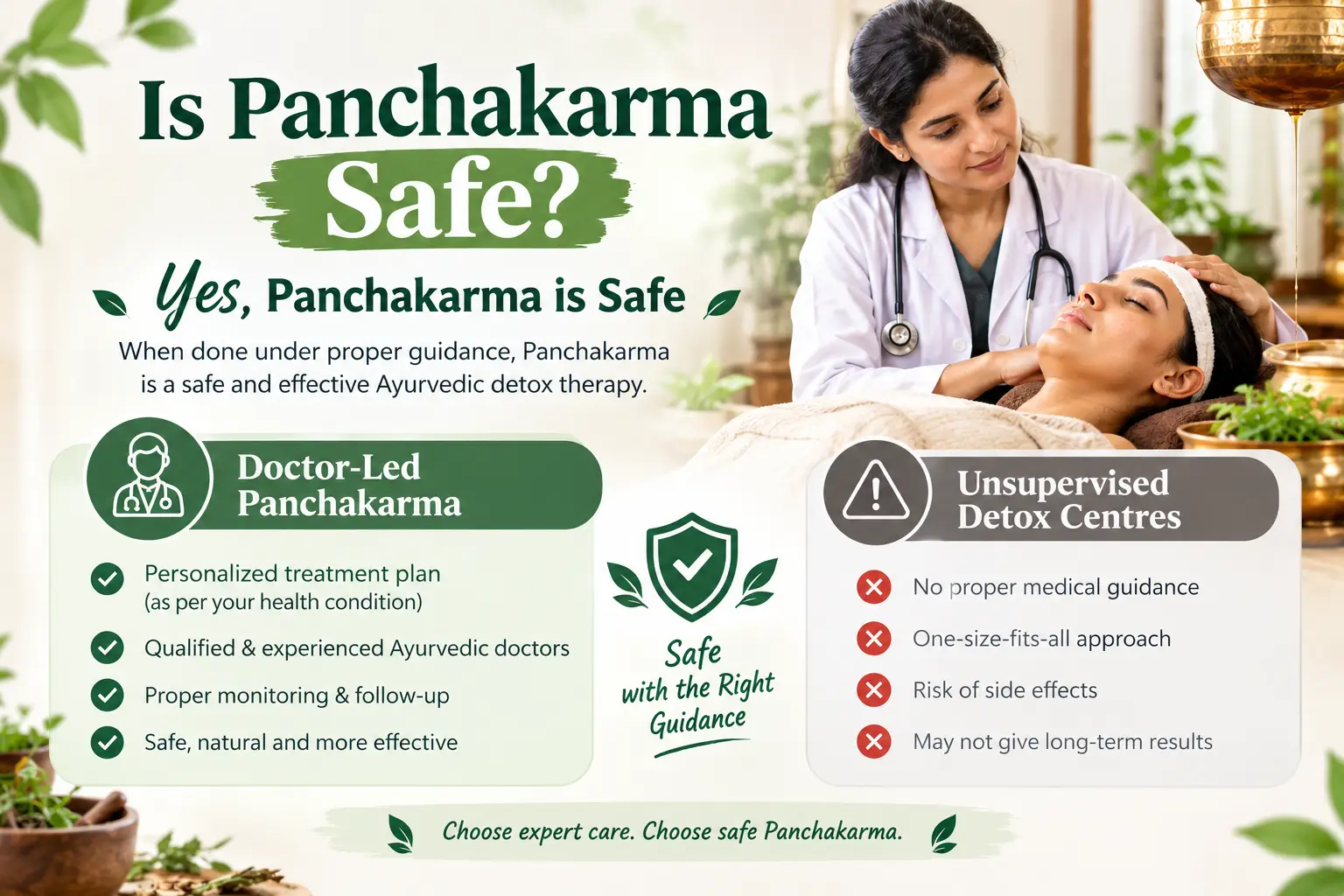
Is Panchakarma safe? Learn the real difference between doctor-supervised and unsupervised Panchakarma, who should be cautious, and what questions to ask before booking.
"Is Panchakarma safe?" is one of the most common questions people ask before booking, and it deserves a direct, honest answer rather than a reassuring but vague one. The short version: Panchakarma, when properly supervised by a qualified Ayurvedic doctor, has a long history of safe clinical use within Ayurvedic medicine. But that safety depends heavily on how it's administered — and this is exactly where the meaningful difference between doctor-led Panchakarma and unsupervised "detox" programs comes in.
This article explains that difference clearly, covers who should be especially cautious, and gives you a practical framework for evaluating any centre's safety standards before you commit.
Is Panchakarma Safe? A Direct Answer
Panchakarma is safe for most healthy adults when it is individually assessed and supervised by a qualified Ayurvedic physician throughout the entire process — not just at an initial sign-off. The therapies involved, including Vamana (therapeutic emesis), Virechana (purgation), Basti (medicated enemas), Nasya (nasal administration) and Raktamokshana (bloodletting, used selectively), have real physiological effects and are not risk-free procedures performed casually. Safety depends on correct patient selection, appropriate protocol design, and ongoing monitoring — the same principles that apply to any structured medical therapy.
What Does "Doctor-Supervised" Actually Mean?
Doctor-supervised Panchakarma means a qualified Ayurvedic physician:
- Personally conducts a detailed health history and constitutional assessment before treatment
- Determines which therapies are appropriate for your specific condition, age and constitution
- Designs an individualized sequence and dosage rather than applying a standard package
- Remains actively involved throughout treatment, not just at the beginning
- Monitors your physical response and adjusts the protocol if needed
- Is reachable and responsible for decisions if complications or discomfort arise
Learn what to look for in a qualified Ayurvedic doctor
This is meaningfully different from a program that uses Panchakarma terminology but is designed and run primarily by therapists, wellness staff, or generic "detox" operators without formal Ayurvedic medical training.
Doctor-Led vs Unsupervised Panchakarma: A Comparison
| Factor | Doctor-Supervised Panchakarma | Unsupervised / Generic Detox Programs |
|---|---|---|
| Initial assessment | Detailed medical history, constitutional evaluation, physical exam | Often minimal or a basic intake form |
| Protocol design | Individualized based on assessment | Frequently standardized for all guests |
| Practitioner qualification | Registered Ayurvedic physician (BAMS or higher) | May be wellness staff, therapists, or unregistered practitioners |
| Ongoing monitoring | Doctor remains involved throughout treatment | Limited or no doctor involvement after intake |
| Handling complications | Doctor available to assess and adjust treatment | Often no clear medical escalation process |
| Medication disclosure | Explicitly reviewed and factored into planning | May not be systematically collected or reviewed |
| Contraindication screening | Individually assessed (pregnancy, chronic illness, age, etc.) | Frequently not addressed at all |
This comparison isn't intended to suggest every non-medical wellness program is unsafe by definition — some are transparent about being general wellness experiences rather than clinical Panchakarma. The concern arises specifically when a program uses Panchakarma's clinical language and implies medical rigor without the actual supervision to back it up.
Why Does Individual Assessment Matter So Much?
Panchakarma therapies are not universally appropriate for every person or every condition. What's suitable for one patient's constitution and current state of health may be inappropriate — or require significant modification — for another. This is why classical Ayurvedic practice places such heavy emphasis on individual diagnosis before treatment begins, rather than applying uniform protocols.
A doctor's assessment determines things like: which specific therapies are appropriate, how intensive the preparatory phase (Purvakarma) needs to be before main treatments begin, what dietary modifications are necessary, and whether any part of the standard sequence should be skipped or adjusted for your situation. Skipping this step in favor of a fixed, one-size-fits-all package removes exactly the safeguard that makes Panchakarma appropriate for the individual receiving it.
Who Should Be Especially Cautious About Panchakarma?
Doctor supervision matters for everyone, but it becomes particularly important — and in some cases, treatment may need significant modification or should be avoided entirely — for:
- Pregnant individuals — many Panchakarma therapies are not appropriate during pregnancy and this should be explicitly discussed and, in most cases, avoided
- Older adults, particularly those with cardiovascular conditions, reduced mobility, or frailty
- Patients on regular prescription medication, especially cardiovascular, psychiatric, or blood-thinning medications
- Patients with chronic conditions such as uncontrolled diabetes, significant hypertension, or autoimmune disorders
- Patients with recent surgery or acute illness
- Children, for whom Panchakarma protocols differ significantly from adult treatment and require specific pediatric expertise
For anyone in these categories, suitability should be assessed individually by a qualified doctor before any commitment to treatment, and this conversation should happen well before travel arrangements are finalized.
Read our guide for international and NRI patients
What Are the Actual Risks If Panchakarma Is Done Poorly?
Being direct about this matters more than vague reassurance. Poorly supervised Panchakarma — particularly involving therapies like Vamana or Virechana administered without proper assessment or monitoring — can lead to complications such as dehydration, electrolyte imbalance, excessive weakness, or aggravation of an underlying condition that wasn't properly screened for beforehand. These risks are precisely why classical Ayurvedic texts emphasize careful patient selection and monitored administration rather than presenting these therapies as universally safe for anyone in any condition.
This isn't intended to be alarming — it's intended to explain clearly why the distinction between doctor-supervised and unsupervised programs is a genuine safety issue, not just a marketing distinction.
Red Flags to Watch For
- No individual consultation before treatment begins, or a consultation that feels rushed and generic
- Reluctance to disclose the treating doctor's or practitioner's qualifications
- A fixed-length, fixed-price "detox package" applied identically to every guest
- No process for reviewing current medications or health conditions
- Promises of guaranteed weight loss, disease cures, or dramatic detox claims
- No clear plan for handling discomfort or complications during treatment
- Pressure to book quickly without time to ask questions
If you notice several of these together, it's worth pausing and asking direct follow-up questions before committing.
What to Ask Your Doctor Before Starting Panchakarma
- Are you a registered Ayurvedic physician, and what is your specific experience with Panchakarma?
- Based on my health history, am I a good candidate for the therapies you're recommending?
- Are there any therapies you would specifically avoid in my case, and why?
- How will you monitor me during treatment, and what happens if I experience discomfort or an unexpected reaction?
- How does my current medication use factor into the plan?
- What does recovery and follow-up look like after the main treatment ends?
A doctor confident in their supervision standards will answer these clearly and specifically, rather than offering generic reassurance.
How Palampur's Doctor-Supervised Centres Approach Safety
In a properly run centre in Palampur — or anywhere else — safety standards should look the same regardless of location: an individual consultation before treatment, a doctor who remains involved throughout, transparent handling of medications and health conditions, and honest communication about who is and isn't a good candidate for specific therapies. Location doesn't change these fundamentals; the quality of medical supervision does.
Compare Panchakarma destinations in India
Making a Confident, Informed Decision
Panchakarma isn't inherently risky, and it isn't inherently completely safe either — like most genuine medical therapies, its safety depends on how carefully it's assessed, administered and monitored. The clearest way to protect yourself is to insist on doctor-led supervision, ask direct questions about qualifications and process, and be honest about your own health history so the treatment plan can actually be designed around your individual needs.
If a centre welcomes these questions and answers them with specificity, that's a far more meaningful safety signal than any marketing claim about being "authentic" or "the best."
FAQ
Is Panchakarma safe for everyone?
Not automatically. Panchakarma is generally safe for most healthy adults when properly assessed and doctor-supervised, but suitability should be individually evaluated, particularly for pregnant individuals, older adults, those on regular medication, and people with chronic conditions.
What's the difference between doctor-led and unsupervised Panchakarma?
Doctor-led Panchakarma involves a qualified Ayurvedic physician personally assessing you, designing an individualized protocol, and monitoring your response throughout treatment. Unsupervised or generic detox programs often apply standardized packages without proper medical assessment or ongoing doctor involvement.
Who should not undergo Panchakarma?
This depends on individual assessment, but caution or avoidance is generally warranted during pregnancy, in cases of acute illness or recent surgery, and for certain chronic conditions unless specifically cleared and closely monitored by a qualified doctor.
Is Panchakarma painful?
Most Panchakarma therapies are not painful, though some — such as therapeutic purgation or emesis — can involve genuine physical intensity and discomfort as part of the intended therapeutic process. A qualified doctor should explain what to expect from each specific therapy beforehand.
How do I know if a Panchakarma centre is properly doctor-supervised?
Ask directly whether a qualified, registered Ayurvedic doctor personally assesses you before treatment and remains involved throughout, rather than assuming this based on a centre's marketing or reputation.
Can Panchakarma be dangerous if done incorrectly?
Yes, particularly therapies like Vamana or Virechana administered without proper individual assessment and monitoring, which can lead to complications such as dehydration or aggravation of an underlying condition. This is why doctor supervision throughout treatment matters.
Is it safe to do Panchakarma without disclosing my medications?
No. Full disclosure of current medications and health conditions is essential, since certain therapies may need to be modified, delayed, or avoided depending on your specific situation.
Should I choose doctor supervision over a cheaper unsupervised program?
This is a decision worth weighing carefully. Doctor-supervised programs involve proper individual assessment and monitoring, which directly affects both safety and the appropriateness of treatment for your specific condition — factors worth prioritizing given what's at stake.