
📞 Book a consultation with our Ayurvedic specialists at Ayush Panchkarma — located in the heart of the Himalayas, Palampur, Himachal Pradesh. Website: ayushpanchkarma.com | Email: doctor@ayushpanchkarma.com
Chronic skin conditions such as psoriasis, eczema, acne, and vitiligo affect millions of people worldwide. While modern dermatology offers important interventions, many individuals also explore traditional systems of medicine for additional support. Ayurveda — India’s classical healing science — has addressed skin disorders for over 2,000 years through its own diagnostic and therapeutic framework.
This article explores the Ayurvedic understanding of skin health, the role of Panchakarma in supportive skin care, and what a traditional residential programme involves. It is intended as an educational resource for those curious about this ancient approach.
1. How Ayurveda Understands Skin Disease
In classical Ayurvedic texts — the Charaka Samhita and Sushruta Samhita — skin disorders are collectively referred to as Kushtha. These texts describe skin health as a reflection of internal balance rather than an isolated surface condition. According to this framework, the skin’s condition mirrors the state of deeper physiological systems, particularly the digestive tract, liver, blood, and lymph.
The Three-Dosha Framework
Ayurveda understands the body through three functional energies called doshas: Vata, Pitta, and Kapha. Each person has a unique constitutional combination (Prakriti), and disease arises when these doshas become imbalanced. In the case of skin disorders, Pitta — associated with heat, metabolism, and transformation — is most commonly implicated, often alongside Rakta (blood) and Rasa (plasma) dhatu (tissue) involvement.
Key Causative Factors According to Ayurvedic Texts
Rakta Dushti (Blood Impurity) — Toxin accumulation in the blood, described in classical texts as manifesting in rashes, discolouration, and skin inflammation
Pitta Aggravation — Excess heat and acidity, associated with burning sensations, redness, oozing, and spreading lesions
Mandagni (Impaired Digestion) — Reduced digestive capacity that leads to Ama (metabolic by-products) accumulating in tissues
Viruddha Ahara — Incompatible dietary combinations that, in the Ayurvedic view, disrupt digestion and contribute to Ama formation
Understanding these causative factors helps explain why Ayurvedic skin treatment focuses on internal detoxification and constitution-specific balancing, rather than only addressing surface symptoms.
2. Skin Conditions Addressed Through Ayurvedic Protocols
Ayurvedic classical literature describes specific protocols for a range of skin conditions. Below is a brief educational overview of how Ayurveda approaches some common conditions. This is not a treatment guide — all Ayurvedic care should be personalised and supervised by a qualified practitioner.
Psoriasis (Kitibha / Sidma Kushtha)
Psoriasis is recognised in Ayurveda under the broad category of Kushtha, with specific sub-types described based on dosha dominance and symptom pattern. Classical protocols for psoriasis-type conditions typically focus on Pitta and Vata pacification, blood purification, and internal cleansing through Shodhana (detoxification) therapies such as Virechana and Takradhara.
Educational Note: Psoriasis is a chronic autoimmune condition. Ayurvedic care is explored by some individuals as a supportive approach. Individual responses to Ayurvedic management vary considerably, and outcomes depend on constitution, disease duration, and adherence to protocols. |
Eczema & Atopic Dermatitis (Vicharchika)
Vicharchika in classical Ayurvedic texts is characterised by symptoms resembling eczema: intense itching, oozing, discolouration, and skin thickening. The Ayurvedic approach focuses on Shodhana therapies (particularly Vamana and Virechana), medicated oil applications (Abhyanga), and dietary adjustments to reduce Pitta and Kapha aggravation.
Acne & Hormonal Skin Issues (Yuvan Pidika)
Yuvan Pidika is described in Ayurveda as a Pitta-Kapha disorder involving blood impurity. Classical management includes Raktamokshana (therapeutic bloodletting, often via medicinal leeches) for localised cystic lesions, Mukhalepam (herbal face preparations), and internal formulations aimed at blood purification and digestive improvement. Hormonal acne associated with PCOS may be addressed through broader hormonal balancing protocols.
Vitiligo (Shwitra)
Shwitra — characterised by progressive depigmentation — has specific Ayurvedic protocols dating back to classical texts. Bakuchi (Psoralea corylifolia) is among the most extensively documented classical herbs used in this context, often applied topically with controlled sun exposure. Internal blood purification and immunomodulatory herbal support are also part of the traditional protocol. Ayurvedic practitioners typically recommend a minimum programme of 45 days for this condition to allow adequate time for assessment.
Urticaria & Skin Allergies (Sheeta Pitta)
Sheeta Pitta is described as a Pitta-Kapha disorder with gut hypersensitivity as a contributing factor. Classical protocols include Virechana, Haridra Khanda, Arogyavardhini Vati, and dietary restructuring targeting Pitta aggravation and gut health.
Other Conditions With Ayurvedic Supportive Protocols
Seborrheic Dermatitis (scalp and face)
Rosacea
Hyperpigmentation & Melasma
Contact Dermatitis
Dry Skin & Skin Ageing Support
Hair fall associated with scalp psoriasis or seborrheic conditions
3. Core Panchakarma Therapies in Skin Programmes
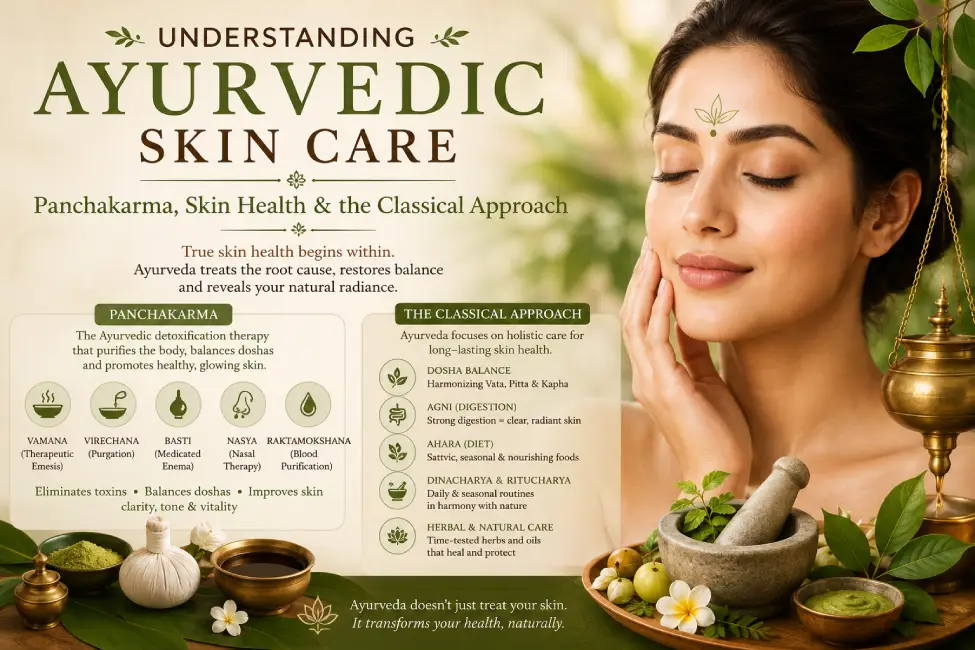
Panchakarma refers to the five primary detoxification procedures described in classical Ayurvedic texts. In the context of skin conditions, specific procedures are selected based on the patient’s dosha profile, condition type, and constitution. All procedures in a classical Panchakarma programme are physician-supervised.
Panchakarma Therapy | Ayurvedic Purpose | Skin Conditions It Supports |
Virechana (Therapeutic Purgation) | Aims to reduce Pitta accumulation and support blood purification through controlled purgation | Psoriasis, Eczema, Acne |
Vamana (Therapeutic Emesis) | Targets Kapha and Ama removal from the upper GI tract | Thick-scaling Psoriasis, Eczema |
Raktamokshana (Leech Therapy) | Classical blood purification technique for localised skin lesions | Cystic Acne, Localised Psoriasis |
Takradhara | Medicated buttermilk stream application — cooling and calming in nature | Severe Itching, Inflammatory Psoriasis |
Abhyanga + Lepa | Medicated oil massage combined with herbal paste external application | All Chronic Skin Conditions |
Each patient’s programme is a customised combination of these therapies, determined after Nadi Pariksha (pulse diagnosis) and Prakriti assessment. No two programmes are identical.
4. The Four Phases of a Panchakarma Skin Programme
A classical residential Panchakarma programme follows a structured progression designed to prepare the body, perform the primary procedures, and support recovery. Here is an educational outline of the four phases:
Phase 1 — Consultation & Assessment
Every programme begins with a comprehensive Ayurvedic consultation. The physician performs Nadi Pariksha (pulse diagnosis), assesses Prakriti, reviews skin condition history, and evaluates lifestyle and dietary habits. From this, a personalised treatment plan is designed specifying procedures, herbal medicines, dietary protocols, and the recommended programme duration.
Phase 2 — Purva Karma / Preparation
Before the main detoxification procedures begin, the body is prepared through Snehana (internal and external oleation with medicated ghee and oils) and Swedana (herbal steam therapy). This preparatory phase is considered essential in the classical protocol, as it loosens and mobilises accumulated doshas from deep tissues towards the GI tract, where they can be eliminated. Herbal medications and dietary protocols also begin during this phase.
Phase 3 — Main Panchakarma Procedures
The core therapeutic procedures — Virechana, Vamana, Raktamokshana, Takradhara, Nasya, or Basti as indicated — are performed under direct physician supervision. Daily Abhyanga (medicated oil massage), Parisheka (herbal stream therapy), and Lepa (herbal paste applications) continue throughout this phase. Residential skin programmes typically range from 14 to 28 days depending on the condition’s severity and the patient’s response.
Phase 4 — Paschat Karma / Post-Treatment Recovery
Following the main procedures, the body enters a recovery and rebuilding phase. A post-treatment diet and Rasayana (herbal tonic) protocol is prescribed to support tissue normalisation. A detailed take-home protocol — covering medicines, dietary guidance, and lifestyle recommendations — is provided at discharge to help patients maintain the gains from treatment in daily life.
5. Classical Ayurvedic Formulations Used in Skin Programmes
The following are among the classical Ayurvedic preparations traditionally used in skin disease management. All formulations used in a clinical setting should be sourced from GMP-certified pharmacies and prescribed only after individual assessment. This list is provided for educational purposes only.
Khadirarishta — A classical fermented preparation with traditional use in skin and blood purification protocols
Panchatikta Ghrita — A five-bitter-herb medicated ghee used in Kushtha (skin disorder) management
Manjisthadi Kwatha — Used in Rakta Shodhana (blood purification) protocols for eczema and dermatitis
Gandhaka Rasayana — A sulphur-based classical Rasayana with documented use across skin conditions
Arogyavardhini Vati — A classical compound used in liver and skin support protocols
Haridra Khanda — A classical preparation with traditional use in allergic and itching skin conditions
Bakuchyadi preparations — Bakuchi-based formulations used in vitiligo management protocols
Sarivadyasava — Used in acne and skin purification protocols
Nimbarishta — A neem-based classical preparation used in Pitta-related skin conditions
Important: Ayurvedic formulations should only be taken under the guidance of a qualified Ayurvedic physician. Self-medication with classical preparations is not advisable. Exact prescriptions are always individualised after consultation and assessment. |
6. Ayurvedic Dietary Guidance for Skin Health
In the Ayurvedic framework, Ahara (food) is considered the primary medicine. Dietary choices directly influence dosha balance, digestive fire (Agni), and the formation or elimination of Ama (metabolic waste). The following guidelines reflect traditional Ayurvedic dietary wisdom for Pitta-type skin conditions — however, individual recommendations must be tailored by a practitioner.
Generally Supportive Foods | Generally Advised to Avoid |
Bitter vegetables: karela, fenugreek, neem leaves, drumstick | Heavily spiced, sour, or salted foods |
Cooling fruits: pomegranate, amla, grapes, coconut, sweet lime | Incompatible food combinations (Viruddha Ahara) |
Light grains: old rice, barley, mung dal | Fermented foods: curd, alcohol, vinegar |
Cow's ghee in moderation (Pitta-pacifying per Ayurveda) | Packaged and processed foods |
Digestive spices: turmeric, coriander, fennel | Nightshades: tomatoes, potatoes, brinjal (especially in psoriasis) |
| Sesame and mustard oil (considered heating in Ayurveda) |
During a residential programme, all meals are typically prepared in line with the prescribed dietary protocol. Individual adjustments are made throughout the programme based on the physician’s daily assessment. Food is regarded as an integral part of the therapeutic process, not a secondary consideration.
7. Frequently Asked Questions
Does Ayurveda cure psoriasis or other chronic skin conditions?
Ayurveda does not make claims to cure chronic conditions. As a classical system of medicine, it offers a supportive, constitution-based management approach that aims to address identified internal imbalances, reduce the frequency and intensity of flare-ups, and support long-term skin health. Individual responses depend significantly on body constitution, disease duration, lifestyle adherence, and other factors.
How long is a typical Ayurvedic skin programme?
A minimum of 14 days is generally considered necessary for mild-to-moderate conditions. For more chronic or complex conditions such as psoriasis, eczema, or vitiligo, 21 to 28 days is typically advised. The physician determines the appropriate duration following individual assessment.
Can children receive Ayurvedic skin treatment?
Ayurvedic procedures are generally adaptable for children, with dosages and treatment intensity adjusted for age and body weight. A prior consultation with the physician is essential to assess suitability for any child’s specific condition.
Is it necessary to stop existing medications before starting Ayurvedic treatment?
No. It is strongly advised not to discontinue any prescribed medication without medical guidance. A qualified Ayurvedic physician will review existing medications during consultation and advise on how Ayurvedic care may complement ongoing treatment. Ayurvedic therapies are supportive in nature and are not a substitute for conventional medical care.
What should I bring or prepare for a residential programme?
Patients are typically advised to arrive with their full medical history, current medications list, and prior dermatology reports. Comfortable, loose cotton clothing suitable for therapies is recommended. The physician will provide detailed preparation guidance at the time of booking.
8. About Ayush Panchakarma, Palampur
Ayush Panchakarma is a physician-supervised Ayurvedic centre located in Gopalpur, Palampur, in the Dhauladhar foothills of Himachal Pradesh. The centre offers classical Panchakarma programmes for chronic skin conditions, metabolic disorders, and general wellness, conducted strictly according to traditional Ayurvedic protocols.
Key Features • Physician-supervised all procedures • Classical protocols from traditional texts • Constitution-based personalisation • Residential care with Ayurvedic meals • Take-home protocol on discharge | Contact & Location V.P.O. Gopalpur, Tehsil Palampur District Kangra, HP 176061 Call / WhatsApp: +91-8894356919 Email: doctor@ayushpanchkarma.com Web: ayushpanchkarma.com |
IMPORTANT DISCLAIMER The information in this article is provided for general educational awareness about Ayurvedic philosophy and traditional practices. It does not constitute medical advice, diagnosis, or treatment. Ayurvedic therapies are supportive and complementary in nature and are not a substitute for professional medical diagnosis or treatment. Individual outcomes vary based on body constitution, lifestyle, disease severity, and programme adherence. No specific results are promised or implied. Always consult a qualified physician before making any changes to your existing medical treatment. |
ayushpanchkarma.com | +91-8894356919 | doctor@ayushpanchkarma.com