
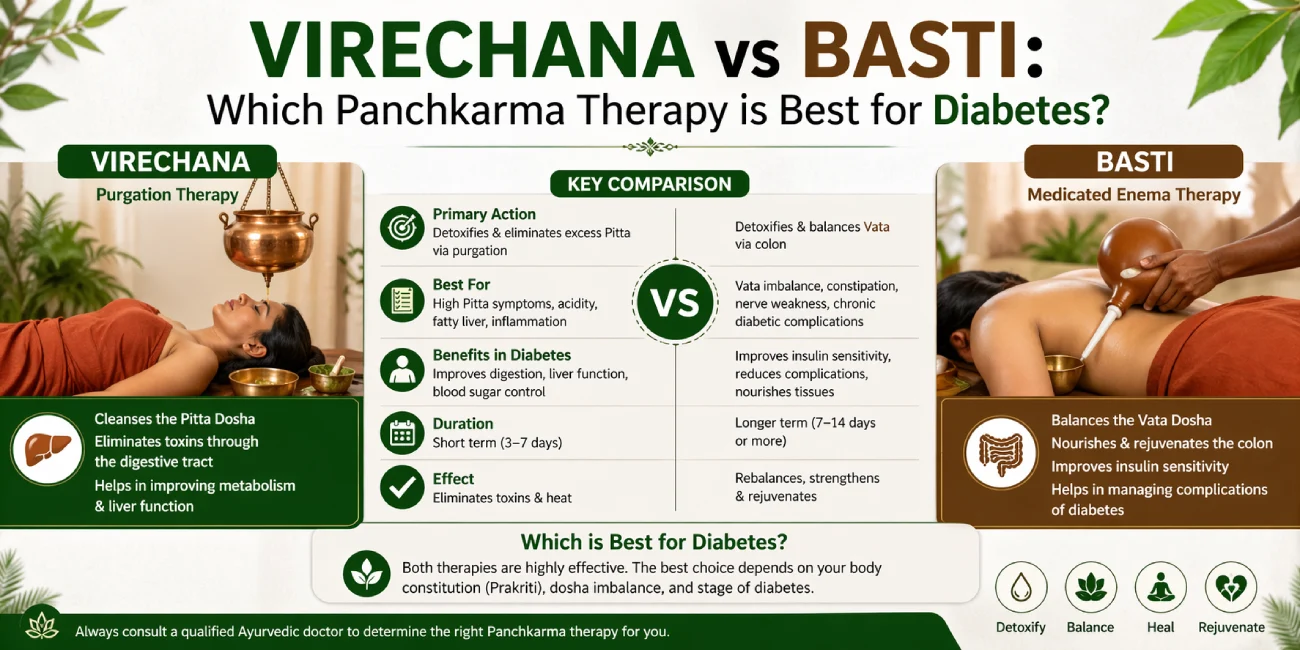
If you or a loved one is considering Panchkarma for diabetes, understanding the difference between these two therapies will help you have a more informed conversation with your Ayurvedic physician. In this blog, we break down both therapies in depth and explain how the right choice is made.
Introduction
Among the five classical Panchkarma therapies, Virechana (therapeutic purgation) and Basti (medicated enema) are the two most frequently recommended for managing diabetes (Madhumeha) in Ayurveda. Both are powerful tools — but they work differently, target different doshas, and suit different patient profiles.
A Quick Recap: What is Panchkarma?
Panchkarma literally means "five actions" — five classical Ayurvedic detoxification procedures:
- Vamana (therapeutic emesis)
- Virechana (therapeutic purgation)
- Basti (medicated enema)
- Nasya (nasal therapy)
- Raktamokshana (bloodletting)
For diabetic patients, Virechana and Basti are the most commonly used, with Abhyanga and Swedana serving as essential preparatory therapies. Vamana may be used in specific Kapha-dominant presentations.
Understanding Virechana
What it is:
Virechana is a controlled, medicated purgation therapy that cleanses the small intestine, liver, gallbladder, and digestive system. It is the primary therapy for pacifying excess Pitta dosha.
How it works (step by step):
- Purvakarma (Preparation, 3–7 days): The patient undergoes Snehapana — consuming increasing amounts of medicated ghee daily to internally oleate the system. This mobilizes Ama and deep-seated toxins from tissues into the digestive tract.
- Virechana Day: The physician administers a medicated herbal purgative formulation. This triggers a systematic, gentle cleansing of the intestinal tract — expelling accumulated toxins, excess Kapha, and Pitta.
- Samsarjana Krama (Recovery, 3–7 days): A carefully graduated diet is followed — starting with light liquid foods and progressively returning to a normal Ayurvedic diet. This phase is critical for rebuilding Agni.
For diabetes, Virechana specifically:
- Improves liver function (crucial for glycogen regulation)
- Clears the Medovaha Srotas (fat channels) — key in Type 2 diabetes
- Reduces inflammation in the digestive system
- Improves Agni and nutrient metabolism
- Reduces Pitta-Kapha imbalance in the intestines
Understanding Basti
What it is:
Basti involves the introduction of medicated herbal decoctions or oils into the colon via the rectum. Despite being counterintuitive to Western thinking, this therapy is one of the most potent in the Ayurvedic system — classical texts call Basti the "half of all treatment" (Ardha Chikitsa), and some even call it the complete treatment.
How it works:
The colon (large intestine) is considered the primary seat of Vata dosha in Ayurveda. By directly administering medicinal substances to the colon, Basti:
- Rapidly pacifies Vata dosha
- Delivers medicinal compounds that are absorbed through the colonic mucosa
- Clears retained Ama from the colon
- Regulates bowel function
Types of Basti used in diabetes:
- Kashaya Basti (Decoction Enema): Made from anti-diabetic herbal decoctions (e.g., Dashamoola, Triphala, Guduchi). Primarily detoxifying and cleansing.
- Anuvasana Basti (Oil Enema): Made from medicated sesame oil or ghee. Primarily nourishing and nerve-supporting. Particularly important for patients with diabetic neuropathy.
A standard Basti course for metabolic disorders involves alternating these two types over 8–16 days (a "Matra Kala" course), designed individually for each patient.
Key Differences: Virechana vs Basti
While both therapies serve the broader goal of detoxification and metabolic restoration, they differ significantly:
Virechana:
- Primary dosha: Pitta (also Kapha)
- Primary organ: Liver, small intestine
- Direction: Downward, eliminative
- Best for: Patients with liver dysfunction, excess Pitta signs (inflammation, acid, skin issues)
- Duration: 1 purgation day + preparation and recovery (total 10–14 days)
- Intensity: Moderate to strong
Basti:
- Primary dosha: Vata (all doshas via colon)
- Primary organ: Colon, nervous system
- Direction: Inward, both cleansing and nourishing
- Best for: Patients with neuropathy, constipation, Vata imbalance, nerve issues
- Duration: 8–16 sessions over 2–3 weeks
- Intensity: Gentle (especially oil Basti)
The fundamental philosophical difference:
Virechana eliminates — it pushes excess doshas and toxins out of the body. Basti both eliminates and nourishes — it removes Ama while also delivering medicinal substances to rebuild tissues. This makes Basti uniquely suited for patients who are both toxic AND depleted — a very common profile in long-term diabetics.
Who Benefits Most from Virechana?
Virechana is generally the preferred choice when:
- The patient is primarily Pitta or Kapha-Pitta type
- There is significant liver involvement (fatty liver, elevated liver enzymes)
- The patient has skin issues (a classic Pitta sign)
- There is excess acidity, inflammation, or heat in the digestive system
- The patient is obese or overweight with good physical strength
- Blood tests show elevated triglycerides and cholesterol alongside blood sugar
Virechana is generally avoided when:
- The patient is very weak, elderly, or emaciated
- There is active diarrhea or inflammatory bowel disease
- The patient is on blood thinners or certain cardiac medications
- Blood sugar is poorly controlled, or there is a risk of hypoglycemia during purgation
Who Benefits Most from Basti?
Basti is generally preferred when:
- The patient shows signs of diabetic neuropathy (tingling, numbness, pain in extremities)
- There is constipation (very common in diabetics, especially those on certain medications)
- The patient is elderly, lean, or has Vata-dominant features
- There is tissue depletion — muscle wasting, dry skin, joint pain
- The patient needs a gentler approach that is both cleansing and nourishing
- There is anxiety, insomnia, or significant stress alongside blood sugar issues
Basti is generally avoided when:
- There is active rectal bleeding or recent bowel surgery
- The patient has severe hemorrhoids (piles)
- There is acute diarrhea or inflammatory bowel conditions
Can Both Be Used Together?
Yes — and in clinical practice, the most effective Panchkarma programs for diabetes often incorporate both therapies in sequence:
The classical protocol often looks like this:
- Preparatory phase: Snehapana (internal oleation) + Abhyanga and Swedana
- Virechana: To clear the primary toxin load from the liver and digestive system
- Post-Virechana recovery diet
- Basti course: To nourish the nervous system and complete the detox of the colon
- Concurrent herbal medicines: Anti-diabetic formulations throughout
- Diet and lifestyle: Kapha-pacifying diet, specific yoga, and pranayama throughout
This combined approach addresses both the metabolic (Pitta-Kapha) and neurological (Vata) dimensions of diabetes, which is why comprehensive programs lasting 14–21 days yield better results than shorter interventions.
The Role of Your Ayurvedic Physician
The most important point to understand is this: the choice between Virechana and Basti — or the decision to use both — cannot be made based on a blog post, a symptom checklist, or a generic protocol.
Your Ayurvedic physician will assess:
- Your Prakriti (constitution) through pulse diagnosis (Nadi Pariksha)
- Your current dosha imbalance (Vikruti)
- Your Agni (digestive fire) strength
- Your Ama (toxin) load
- Your current medications and blood sugar control
- Your overall physical strength (Bala)
Only after this comprehensive assessment will the appropriate therapy — and the correct sequencing, duration, and intensity — be determined.
At Ayush Panchkarma in Palampur, every patient undergoes a thorough initial consultation before any treatment begins. We monitor blood sugar levels throughout the program to ensure safety.
Begin Your Personalized Panchkarma Journey
Whether you are newly diagnosed with Type 2 diabetes, a long-term patient looking for complementary support, or someone with pre-diabetes wanting to prevent progression, Ayurvedic Panchkarma offers a safe, holistic, and deeply personalized approach.
Book your consultation with our Ayurvedic physicians at Ayush Panchkarma, Palampur: https://ayushpanchkarma.com/book-appointment
We will assess your unique profile and design a program that works with your body — not against it.