
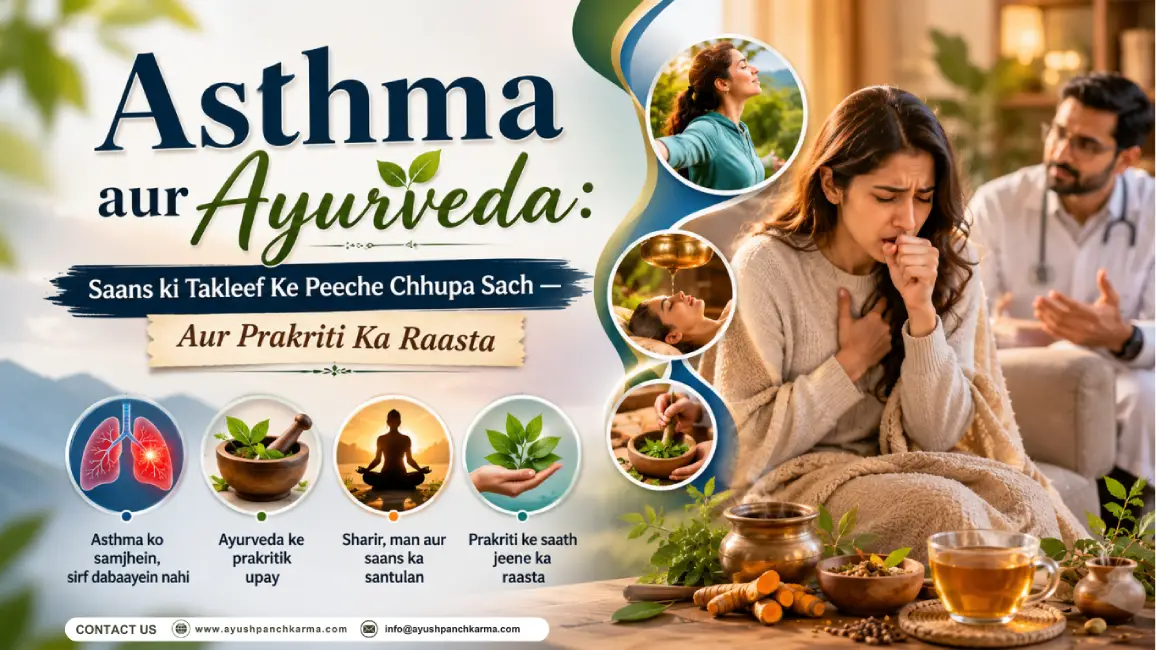
📞 Book a consultation with our Ayurvedic specialists at Ayush Panchkarma — located in the heart of the Himalayas, Palampur, Himachal Pradesh. Website: ayushpanchkarma.com | Email: doctor@ayushpanchkarma.com
It's 2 AM and you're sitting bolt upright, fighting for air. Or maybe it's not that dramatic — just a tight chest every winter that won't quite let go, or a wheeze that shows up the moment someone vacuums the carpet. If any of that sounds familiar, you already know something most pulmonology textbooks don't say out loud: asthma isn't really a lung problem. It's a whole-body pattern that shapes your sleep, your work, your confidence, and the small decisions you make every single day.
This guide comes from years of clinic experience treating patients seeking Ayurvedic treatment for asthma in Palampur, Himachal Pradesh at Ayush Panchakarma. We walk through how Ayurveda reads asthma differently from modern medicine, what Panchakarma actually does to the respiratory system at a root-cause level, and what you can start doing today — through food, daily rhythm, and awareness — to breathe easier.
What Your Inhaler Isn't Telling You
An inhaler opens your airways in seconds. That's genuinely useful, and during an acute attack it can save a life. But it never answers the one question that actually matters: why do your airways keep narrowing in the first place?
Modern medicine frames asthma as a chronic inflammatory airway disease with a genetic component, set off by allergens, cold air, exercise, or infections. Bronchodilators relax the spasm. Corticosteroids calm the inflammation. Useful — but they manage the symptom without touching the terrain that makes your airways reactive.
Ayurveda starts somewhere else. The Charaka Samhita describes Tamaka Shwasa — the classical equivalent of bronchial asthma — breathlessness worse at night and in cold weather, wheeze, chest pressure, relief on sitting upright. That's why Panchakarma for respiratory disorders has remained serious clinical practice rather than folklore.
The root cause is a Vata-Kapha imbalance layered with Ama (undigested metabolic waste) lodged in the Pranavaha Srotas (respiratory channels). Treating that imbalance is the goal of our permanent Ayurvedic treatment for asthma programme in the Himalayan foothills.
Vata, Kapha, and the Lungs: Ayurveda's Map of Respiratory Disease
Two doshas drive most of what happens in an asthmatic lung.
Kapha: The Mucus Dosha
Kapha governs lubrication and structure. Problems start when Kapha gets aggravated — by cold, damp weather, heavy or oily food, excess dairy, too little movement, or daytime sleeping. It piles up in the lungs as the sticky, cold, heavy mucus every asthma patient knows: post-nasal drip worse at night, congestion on waking, wheeze that eases with movement and returns by evening.
Vata: The Spasm Dosha
Vata governs movement — breath included. Cold air, dry environments, irregular routines, overexertion, anxiety — all aggravate Vata. An aggravated Vata disrupts Prana Vata, the subtype governing breathing. Instead of smooth, coordinated breaths: erratic, shallow, or obstructed breathing. Vata also drives bronchial muscle spasm — the defining event of an asthma attack.
Ama: The Hidden Trigger Causing Airway Hyperresponsiveness
Ama is the sticky metabolic residue left behind when Agni (digestive fire) is too weak to fully process food or environmental input. It settles in the Pranavaha Srotas, making the respiratory lining hypersensitive — exactly what modern allergy medicine calls "airway hyperresponsiveness." Every trigger (dust, cold, smoke, stress, pollen) sets off an exaggerated reaction because the channels are already loaded. This is why patients searching for a natural cure for asthma in Ayurveda must address Ama at its root.
Why Symptoms Spike at Night and in Winter
Kapha peaks between 6–10 PM and 6–10 AM, which matches when most patients report their worst symptoms. Vata peaks between 2–6 AM — hence the classic pre-dawn asthma attack. Winter and monsoon are Kapha-heavy seasons, so symptoms reliably flare then too. Once you know this rhythm, you can prepare for the vulnerable hours.
The Gut-Lung Connection: Why Digestion Is the Key to Breathing
One of the most striking Ayurvedic claims about asthma — now being confirmed by modern microbiome research — is this: your breathing trouble may actually start in your gut.
Weak Agni is the upstream cause of Ama. Someone with chronically poor digestion — bloating after meals, irregular bowel habits, a coated tongue, low appetite — is manufacturing Ama around the clock, and that Ama migrates to the respiratory channels. That's why so many asthma patients also deal with food sensitivities, IBS, or chronic constipation. Contemporary peer-reviewed research on the gut-lung axis in asthma describes a bidirectional relationship between gut microbiota and airway immune function — a different vocabulary for a strikingly similar pattern.
This is why our approach to Ayurvedic treatment for respiratory and digestive disorders never separates the gut from the lungs — treating digestion is part of the same programme. See the full scope on our
Full scope of conditions treated: Diseases We Support at Ayush Panchakarma
Best Panchakarma Treatment for Asthma: Core Root-Cause Therapies
Panchakarma is not a spa package. It is a physician-supervised medical detoxification protocol designed to clear Ama from the body's deep channels, correct doshic imbalance, and restore the body's self-regulating capacity. Our Panchakarma packages for asthma are built around these therapies:
|
Therapy |
What It Is |
Dosha Target |
Role in Asthma Treatment |
|
Vamana |
Therapeutic emesis |
Kapha + Ama in lungs |
Removes deep mucus congestion — most important for asthma |
|
Virechana |
Purgation therapy |
Pitta + Ama in gut-blood |
Clears systemic inflammation |
|
Nasya |
Nasal oil instillation |
Vata in upper channels |
Opens sinuses, supports airways — ideal for allergic asthma |
|
Abhyanga |
Full-body herbal oil massage |
Vata aggravation |
Calms nervous system, reduces anxiety-driven spasm |
|
Swedana |
Herbal steam therapy |
Ama in body channels |
Liquefies and mobilises Ama for elimination |
|
Dhoomapana |
Medicated smoke inhalation |
Kapha in respiratory tract |
Directly dries and clears mucus from lungs |
|
Shirodhara |
Warm oil on forehead |
Vata / nervous system |
Reduces anxiety and sleep disruption associated with asthma |
How the Asthma Panchakarma Programme Is Structured
Every Panchakarma track at Ayush Panchakarma runs through four phases: Ayurvedic diagnosis and consultation, Purva Karma (oleation and steam preparation), Pradhana Karma (core detox procedures), and Paschat Karma (rejuvenation and structured post-treatment plan). Read the full process on our Panchakarma approach page.
Vamana — Most Effective Procedure for Kapha-Dominant Asthma
Vamana is therapeutic emesis: a controlled, physician-supervised procedure where the patient takes a specifically prepared herbal emetic after several days of oleation and steam preparation. It pulls excess Kapha and Ama from the stomach and lungs through the upper GI route. Classical texts name Vamana as the primary procedure for Tamaka Shwasa — and clinically, most patients notice a real shift in chest congestion, breathlessness, and sleep quality after a properly conducted session.
Vamana is a medical procedure done under direct physician supervision. It is not something to attempt at home.
Nasya — Opening the Root of the Respiratory Channels
The nose is the doorway to the Pranavaha Srotas. Nasya is the instillation of warm medicated oil or herbal preparations into the nostrils. It clears Ama and Kapha from the nasal passages, sinuses, and upper airways, and calms hypersensitivity of the nasal and bronchial lining. Particularly effective for asthma with sinusitis, allergic rhinitis, or post-nasal drip. Nasya is one of the few Panchakarma procedures patients continue gently at home as part of the take-home protocol.
Dhoomapana — Medicated Smoke for Respiratory Clearing
Dhoomapana uses specially prepared herbal preparations — nothing resembling tobacco — to dry out and clear accumulated Kapha and Ama from the respiratory tract. Patients often feel an almost immediate opening in the airways. Used selectively in Kapha-dominant presentations only.
Best Ayurvedic Medicines for Asthma: Herbs Traditionally Used
Alongside Panchakarma, our physicians prescribe classical herbal formulations individualised to each patient's constitution. These are the herbs most commonly used in Ayurvedic asthma treatment:
Vasa (Adhatoda vasica) — the most important herb in Ayurvedic respiratory medicine; traditionally used to ease bronchial discomfort and clear mucus from the airways.
Yashtimadhu (Glycyrrhiza glabra / Licorice) — Kapha-pacifying, soothes the throat and upper respiratory lining; a staple in Kasa and Shwasa formulations.
Pippali (Long Pepper) — reduces Kapha and kindles Agni; classically paired with honey to clear lung mucus.
Tulsi (Ocimum sanctum / Holy Basil) — pacifies Vata and Kapha; classically indicated for fever, congestion, and airway support.
Haridra (Curcuma longa / Turmeric) — strong anti-Ama herb with broad use in inflammatory and allergic conditions; often taken with warm milk for respiratory complaints.
Kantakari (Solanum xanthocarpum) — a classical Tamaka Shwasa herb, found in many traditional bronchial decoctions.
Shringi (Pistacia integerrima) — primary herb in formulations for childhood asthma and recurrent respiratory infection.
Sitopaladi Churna, Talisadi Churna, Chyavanprash — classical compound formulations widely used across respiratory care protocols.
Every herbal prescription is individualised after physician consultation, sourced exclusively from GMP-certified Ayurvedic pharmacies.
Ayurvedic Diet for Asthma: Food as Medicine
Diet isn't a footnote in Ayurvedic care — it's treatment. What you eat directly shapes how much Ama you produce, how aggravated Kapha gets, and how reactive your airways stay.
Eat More Of: Kapha-Reducing, Agni-Kindling Foods
Warm, freshly cooked meals at consistent times — meal timing alone strengthens Agni and keeps Ama down.
Aged rice, barley, mung dal, and light lentil soups — the backbone of a Kapha-reducing diet.
Ginger, black pepper, long pepper, turmeric, garlic — daily, not occasionally.
Warm water through the day, especially first thing in the morning — dissolves Ama in both the digestive and respiratory channels.
Honey (small amounts, room temperature) — classical texts treat honey as the most useful dietary substance for Kapha disorders including asthma.
Pomegranate, amla, and other light, warm seasonal fruit.
Avoid: Ama-Forming, Kapha-Aggravating Foods
Excess dairy — cold milk, curd, paneer, ice cream. Cold dairy is one of Ayurveda's biggest Kapha triggers and a commonly reported asthma trigger.
Cold water and cold drinks — they blunt digestive fire and add to respiratory Kapha.
Heavy, fried, or processed food — fast Ama generation on a strained Agni.
Bananas, watermelon, and cold, heavy fruit — specifically contraindicated when Kapha is dominant.
Rice flour, refined wheat, maida-based food — sticky, slow to digest, Ama-forming.
Eating late at night — food after 7 PM is poorly digested; leftover Ama builds up overnight when Kapha is already peaking.
Sleeping right after a meal — suppresses Agni and piles on Kapha.
Pranayama and Yoga for Asthma: Breath as Medicine
No respiratory programme is complete without Pranayama. It is woven into treatment from week one and carried forward as part of the take-home protocol. Regular practice strengthens respiratory muscles, increases vital capacity, reduces hyperventilation from stress, calms Vata-driven nervous system reactivity behind bronchial spasm, and improves coordination of Prana Vata.
Pranayama Practices for Asthma Treatment
Anulom Vilom (Alternate Nostril Breathing): the single most broadly useful Pranayama for asthma. Balances Vata and Kapha, clears both nostrils, settles the nervous system. Ten minutes a day shows measurable change within weeks.
Bhramari (Humming Bee Breath): vibration has a direct calming effect on the bronchial tree — particularly helpful for anxiety-triggered asthma and nighttime attacks.
Dirgha Shwasa (Deep Breathing): trains full lung capacity and breaks the rapid-shallow breathing habit typical in chronic asthma.
Kapalbhati: useful in Kapha-dominant cases for clearing mucus — only under guidance, never during a Vata-aggravated phase or active breathlessness.
We also build in specific Yoga postures that open the chest, strengthen respiratory muscles, and correct posture — since a forward-bent posture compresses the diaphragm and reliably worsens asthma.
Why Clean Mountain Air in Palampur Is Part of the Treatment
Most patients arriving for asthma treatment in Himachal Pradesh at our Palampur centre notice a change in breathing within 24 to 48 hours — before treatment has even started. The Kangra Valley, sitting in the foothills of the Dhauladhar range, carries a fraction of the particle and allergen load you'd find in most Indian cities.
PM2.5, PM10, traffic exhaust, industrial pollution, indoor mould, and urban dust rank among the most powerful known asthma triggers. Pulling a patient out of that environment, even temporarily, drops the inflammatory load on the respiratory system fast — and that's exactly what lets Panchakarma procedures do their work properly.
Classical Ayurveda has a name for this: Desha, the therapeutic property of a place. The Himalayan foothills are specifically called out in Ayurvedic texts as beneficial for Kapha and respiratory conditions — air that's clean, dry enough to reduce Kapha, cool enough to pacify Pitta.
Learn about where you'll stay: Homestay & Accommodation in Palampur
Combine treatment with Yoga, meditation, and deeper Ayurvedic lifestyle immersion: Panchakarma Retreats in Himachal Pradesh
Related Conditions Treated Together
Asthma rarely appears alone. These conditions are addressed as part of the same underlying imbalance:
Allergic rhinitis and chronic sinusitis — linked to asthma through the same Pranavaha Srotas; Nasya and Vamana protocols treat both together. See our Specialised Treatments page.
Eczema and urticaria — the 'atopic triad' (asthma + eczema + allergic rhinitis) is treated together on our Ayurvedic skin treatment programme.
IBS, chronic constipation, acid reflux — same upstream cause (weak Agni, excess Ama) as asthma; covered in our disease management programmes.
Anxiety, panic disorder, chronic stress — Vata-driven states that directly worsen bronchial reactivity; addressed through Shirodhara, Abhyanga, and classic Ayurvedic therapies.
For more on Ayurvedic respiratory care and Panchakarma, visit the Ayush Panchakarma Blog.
What a Realistic Ayurvedic Asthma Treatment Journey Looks Like
We'd rather be honest than impressive.
Panchakarma doesn't cure asthma in one sitting. The respiratory channels took years to load up with Ama, and the doshic imbalance has roots in constitution, diet, environment, and long-standing habit. A properly run 14- to 21-day residential programme, with full dietary compliance and physician supervision, brings real change for most patients: fewer and milder attacks, better sleep, less reliance on a bronchodilator, better exercise tolerance, and a much clearer sense of personal triggers.
Maintaining progress takes effort after returning home. The take-home protocol — medicines, diet, Pranayama, Nasya, and seasonal adjustments — matters just as much as the residential programme. Patients who stick with the diet and daily Pranayama tend to hold and build on their gains.
Minimum Recommended Stay for Asthma Treatment
The duration of your Panchakarma programme depends on how long the Ama has been building up in the Pranavaha Srotas, how severe the doshic imbalance is, and whether other conditions — sinusitis, eczema, digestive disorders — are part of the same picture. Below is a general guide based on our clinical experience:
|
Condition Type |
Duration |
Key Procedures Involved |
What You Can Expect |
|
Mild seasonal asthma / allergic asthma (occasional attacks, no daily inhaler) |
14 days |
Nasya, Abhyanga, Swedana, Virechana, Pranayama training |
Reduced frequency of attacks, lower sensitivity to seasonal triggers, better sleep |
|
Moderate persistent asthma with regular inhaler use |
21 days |
Vamana, Nasya, Virechana, Abhyanga, Swedana, Dhoomapana, herbal protocol |
Measurable reduction in inhaler dependence, improved exercise tolerance, deeper sleep |
|
Severe asthma with co-conditions: sinusitis, eczema, IBS, digestive disorders |
21–28 days |
Full Panchakarma sequence: Vamana, Virechana, Nasya, Basti, Shirodhara, extended herbal protocol |
Comprehensive doshic reset; gut, lung, and skin conditions addressed together at the root |
|
Childhood asthma (Bala Tamaka Shwasa) — ages 5 and above |
Minimum 14 days |
Gentle Panchakarma, paediatric-dose herbal formulations, dietary guidance for parents, Pranayama |
Fewer attacks, reduced steroid use, stronger immunity; parent stays on-site throughout |
Important: These are general clinical guidelines, not fixed packages. Your exact programme duration, procedures, and herbal prescription are always decided after a detailed initial physician consultation — based on your constitution (Prakriti), current doshic state (Vikriti), severity of condition, and health history. No two asthma programmes at Ayush Panchakarma are identical.
What Happens During Each Phase of Your Stay
Days 1–3 (Ayurvedic Diagnosis + Purva Karma Preparation): Your physician conducts a full Prakriti-Vikriti analysis, tongue and pulse diagnosis, and medical history review. Snehana (internal and external oleation with medicated ghee and oils) begins to loosen deep-seated Ama from the body's channels. Mild herbal preparations start to strengthen Agni. Many patients already notice easier breathing and better sleep within these first few days.
Days 4–7 (Swedana + Pre-Procedure Softening): Herbal steam therapy (Swedana) is added daily alongside continued oil massage (Abhyanga). This phase liquefies accumulated Ama and moves it toward the digestive tract for elimination. Chest congestion typically starts to loosen noticeably here.
Days 8–14 (Pradhana Karma — Core Detox Procedures): The primary Panchakarma procedures — Vamana, Nasya, Virechana, and Dhoomapana as indicated — are conducted under direct physician supervision. This is where the deepest clearing of Kapha and Ama from the Pranavaha Srotas happens. For 21- and 28-day programmes, this phase is longer, with additional sessions and deeper protocols.
Final Days (Paschat Karma — Rejuvenation + Take-Home Protocol): Rasayana (rejuvenating herbal formulations) are introduced to rebuild Ojas and strengthen respiratory immunity. Your physician finalises your take-home protocol: medicines, diet plan, Pranayama sequence, daily Nasya, and seasonal precautions. This phase is just as important as the detox — it's what determines how long your results last.
Exact duration is confirmed after your initial physician consultation, based on your specific history and condition.
Frequently Asked Questions About Ayurvedic Asthma Treatment
Can Ayurveda permanently cure asthma?
Ayurveda does not promise a single-visit cure, but long-term remission — with significantly fewer attacks, reduced dependence on inhalers, and improved quality of life — is a realistic and commonly achieved outcome for patients who complete a full Panchakarma programme and follow the post-treatment protocol. The goal is to treat the root imbalance (Vata-Kapha + Ama in Pranavaha Srotas), not just suppress symptoms.
Is Ayurvedic asthma treatment safe alongside my inhaler?
In the vast majority of cases, yes. Our approach is complementary by design and does not conflict with bronchodilators or inhaled corticosteroids. Your physician reviews your current medication during the initial consultation, and we never advise stopping a prescribed medication without your doctor's approval.
Can Panchakarma help with allergic asthma triggered by dust and pollen?
Yes. Allergic asthma — driven by an overactive immune response to environmental triggers — maps onto a Vata-Kapha imbalance with Ama in the Pranavaha Srotas. Vamana and Nasya work to clear that Ama so the airways stop overreacting. Many patients report noticeably lower sensitivity to their usual triggers after a complete course of treatment.
What is the Ayurvedic treatment for childhood asthma?
Childhood asthma (Bala Tamaka Shwasa) has its own dedicated tradition within Ayurvedic paediatric medicine (Kaumarabhritya). Protocols are adjusted for children: gentler Panchakarma, lower herbal doses, specific dietary guidance for parents. Shringi, Vasa, and Sitopaladi Churna are common herbs here. We treat children from age 5 upward, with a parent staying on-site throughout.
How fast will I see results from Ayurvedic asthma treatment?
Most patients notice easing of chest congestion and better sleep within the first week (Purva Karma preparation phase). Bigger shifts in breathlessness, exercise tolerance, and attack frequency show up from the second week on. The full effect of a Panchakarma programme often becomes clearest two to four weeks after it ends, as the body's own repair processes continue.
Is Vamana (therapeutic emesis) uncomfortable?
Vamana involves controlled, physician-supervised emesis after several days of oleation and steam preparation. It is not comparable to ordinary illness-related vomiting — the body is fully prepared, and the procedure is brief. Most patients describe a strong sense of relief and lightness in the chest right afterward.
I live outside Himachal Pradesh — how do I plan a visit?
The nearest airport is Gaggal (Dharamsala Airport), about 30 minutes from Palampur. Pathankot (Punjab) and Chandigarh are the closest major railway stations. Our team assists with travel planning — book a consultation online and we'll walk you through the logistics.
Why trust this guide: This article is written and medically reviewed by the practicing physicians at Ayush Panchakarma, an Ayurvedic Panchakarma centre in Palampur, Himachal Pradesh. Ayurvedic claims about Tamaka Shwasa (bronchial asthma) reflect classical texts and peer-reviewed clinical research indexed on PubMed/PMC. Modern mechanistic claims about the gut-lung axis are drawn from recent peer-reviewed review literature. We update this page as new research and clinical experience inform our protocols.
Start Your Asthma Treatment Journey
Speak with our Ayurvedic physician about the right Panchakarma programme for your respiratory condition, in the clean mountain air of Palampur, Himachal Pradesh.
Book Appointment: https://ayushpanchkarma.com/book-appointment
WhatsApp / Call: +91-8894356919
Email: doctor@ayushpanchkarma.com
Quick Navigation — Internal Links
Asthma Ayurvedic Treatment (Main Page): ayushpanchkarma.com/specialised-treatment/asthma-ayurvedic-treatment
Panchakarma Approach: ayushpanchkarma.com/panchakarma-approach
Specialised Treatments: ayushpanchkarma.com/specialised-treatments
Diseases We Support: ayushpanchkarma.com/diseases-we-support
Disease Management Programmes: ayushpanchkarma.com/disease-management-programmes
Panchakarma Retreats Himachal Pradesh: ayushpanchkarma.com/panchakarma-retreats-himachal-pradesh
Ayurvedic Skin Treatment: ayushpanchkarma.com/ayurvedic-skin-treatment
Classic Ayurvedic Therapies: ayushpanchkarma.com/classic-ayurvedic-therapies
Homestay & Accommodation Palampur: ayushpanchkarma.com/homestay-accommodation-palampur
Book Appointment: ayushpanchkarma.com/book-appointment
Blog: ayushpanchkarma.com/blog
Disclaimer: This article is for educational purposes only and does not constitute medical advice, diagnosis, or treatment. Ayurvedic therapies are supportive and complementary in nature. Individual outcomes depend on body constitution, lifestyle, condition severity, and adherence to the treatment programme; results vary by patient. Please consult your physician before changing any existing medical treatment, including inhaler or medication use.