
📞 Book a consultation with our Ayurvedic specialists at Ayush Panchkarma — located in the heart of the Himalayas, Palampur, Himachal Pradesh. Website: ayushpanchkarma.com | Email: doctor@ayushpanchkarma.com
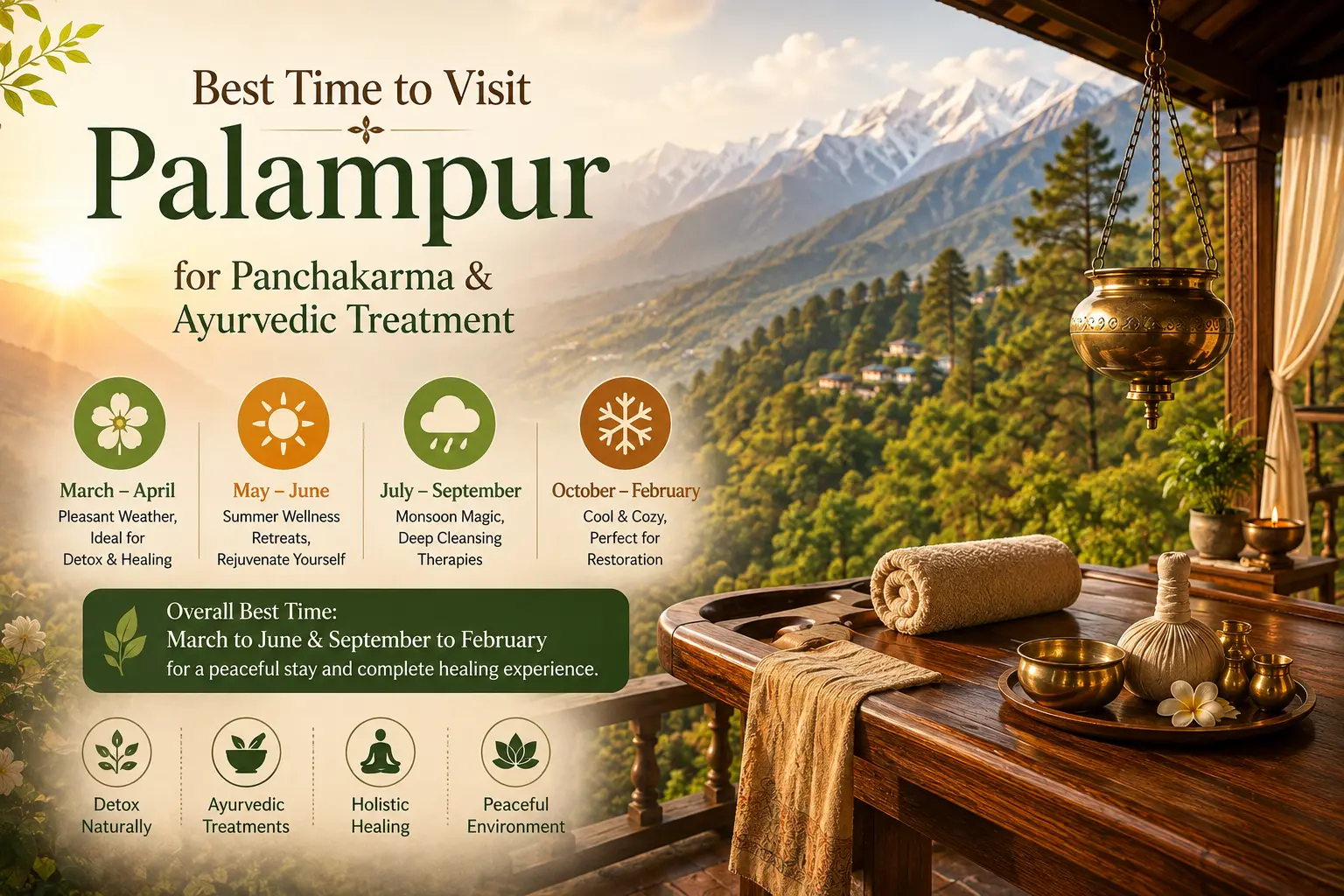
Timing matters more for a Panchakarma trip than for an ordinary holiday. You're not just picking pleasant weather for sightseeing — you're picking a season that supports a multi-day medical detox, plus a route into the Himalayan foothills that stays accessible for the length of your stay. Here's how the two considerations that actually matter — Palampur's real climate, and classical Ayurvedic seasonal guidance (Ritucharya) — line up, and where they pull in different directions.
Why Palampur's Location Makes Timing Extra Important
Palampur sits in the Kangra Valley at the base of the Dhauladhar range, at a moderate elevation surrounded by tea estates and pine forests. This gives it a naturally mild climate for most of the year, but it also means the town experiences real seasonal swings — heavy monsoon rain, occasional winter cold snaps, and a long, comfortable window in between. None of this is extreme by Himalayan standards, but it's enough to meaningfully change your travel experience depending on when you go, especially if you're planning a stay of two weeks or longer.
Palampur Weather, Season by Season
A Month-by-Month Breakdown
January: Cold, clear mountain air, occasional snow in higher areas nearby. A quiet month with very few tourists — good for privacy, but pack proper winter layers.
February: Similar to January but temperatures begin gradually rising toward the end of the month. Also the window for Holi-related preparations, celebrated over several days in the region.
March: Transitional month — days turn noticeably warmer while nights stay cool. Tea gardens begin greening up. One of the better all-round months to travel.
April: Considered one of the most pleasant months, with clear skies, blooming landscapes, and comfortable daytime temperatures.
May: Similar to April, slightly warmer during the day. Still well before monsoon, so travel remains reliable.
June: Warm days, cooler evenings, and the last stretch before monsoon rains typically begin — a good window if you want summer travel without rain risk.
July: The wettest month of the year, with heavy, sustained rainfall. Beautiful greenery, but road conditions in the hills need extra caution.
August: Continued monsoon activity with high humidity, though slightly less rainfall than July on average.
September: Rain gradually tapers off through the month; this is also when the local Sair Festival is celebrated with fairs and folk dances in the region.
October: Skies clear noticeably, humidity drops, and temperatures become comfortable again — a strong month for both travel and outdoor recovery time.
November: The driest month of the year in Palampur, with excellent visibility of the Dhauladhar range and mild, comfortable temperatures.
December: Cold sets in, occasional snowfall in higher elevations nearby, and the town takes on a quieter, more introspective character.
What Ayurveda Says About Seasonal Timing (Ritucharya)
Classical Ayurveda doesn't treat every month as equal for detox therapy. Ritucharya — the science of seasonal routine — divides the year into six ritus (seasons) and links the body's natural dosha accumulation and release cycle to each of them. Understanding this cycle in brief helps explain why Ayurvedic physicians think about timing differently than a typical travel guide would.
Through the year, doshas move through three stages in each season: Sanchaya (gradual accumulation), Prakopa (aggravation), and Prashamana (pacification or release). Panchakarma therapies are traditionally timed to work with this natural cycle rather than against it — treating a dosha right as it's naturally beginning to loosen, rather than forcing detox against the season's tendency.
Shishira Ritu (Late Winter, roughly mid-Jan to mid-March): A time of Kapha accumulation beginning, generally considered a preparatory period rather than an active treatment window.
Vasant Ritu (Spring, roughly mid-March to mid-May): Traditionally considered ideal for Vamana therapy, as Kapha accumulated over winter naturally loosens with the warming weather.
Grishma Ritu (Summer, roughly mid-May to mid-July): Pitta begins to accumulate as heat rises; generally a time for lighter, cooling routines rather than intensive detox.
Varsha Ritu (Monsoon, roughly mid-July to mid-September): Classically associated with Basti therapy, since the digestive fire (Agni) behaves differently in this season — though practical travel conditions in the hills need extra planning during heavy rain.
Sharad Ritu (Autumn, roughly mid-September to mid-November): Traditionally recommended for Virechana, to manage Pitta that has accumulated through the summer months.
Hemanta Ritu (Early Winter, roughly mid-Nov to mid-Jan): Considered a time of strong digestive fire and good bodily strength, often suited to Rasayana (rejuvenation) therapies.
In practice, this means the "best" season isn't only about comfortable travel weather — it can also depend on which therapy your doctor prescribes for your specific condition. This is exactly why the timing conversation happens during your consultation, not before it. A patient needing Virechana for a Pitta-related skin condition may be advised toward autumn, while someone needing Vamana for a Kapha-related respiratory issue may be guided toward spring — even if both are asking "what's the best time to visit" the same week.
So, What's the Best Time to Visit Palampur for Panchakarma?
How to Reach Palampur — Season-Proofing Your Journey
Whatever month you choose, it helps to know your route options in advance, since road conditions are the one variable that changes most with the seasons:
By air: Gaggal (Kangra) Airport is the nearest, roughly 35–40 km from Palampur, connected onward by road.
By rail: Pathankot is the nearest major railhead, around a 2-hour onward journey to Palampur by road; a narrow-gauge line also connects Palampur toward Kangra.
By road: Palampur is well connected to Dharamshala, Kangra, Pathankot, and further out, Chandigarh and Delhi, via NH154 and NH503.
During monsoon months, it's worth checking road conditions a day or two before travel and building a small buffer into your itinerary, especially if you're driving in from Chandigarh or Delhi.
Practical Travel Tips by Season
March – June
Book your place in advance — this is peak travel season for Palampur.
Pack light cottons for the day and a light layer for cooler evenings.
Carry sun protection; days can get warm by late May and June.
July – September
Check road conditions before travel, especially if driving from Pathankot or Chandigarh.
Build a buffer day into your travel plan in case of weather delays.
Pack quick-dry clothing and a light waterproof layer.
October – November
This is often the least crowded of the "good weather" windows — a solid choice if you prefer a quieter stay.
Carry a light jacket for cooler mornings and evenings.
Visibility of the Dhauladhar range is typically at its best this time of year.
December – February
Pack proper winter wear — night-time temperatures can fall well below what visitors expect from "North India."
Confirm heating arrangements at your homestay in advance.
If traveling around Holi (Feb–March), note that celebrations in the region can run for several days.
Combining Panchakarma with Sightseeing: What's Realistic by Season
Combining Panchakarma with sightseeing requires careful planning because, some active detox panchkarma treatment days’ demand rest and particular food regimen. You can enjoy short, calm outings like tea estate walks or temple visits. During the lighter phases, depending on the season and your doctor's advice you can plan half day or longer outings.
Palampur's surroundings offer gentle options worth asking about during quieter phases of your program: short walks through the tea estates, the Neugal Khad viewpoint, and nearby temples such as Baijnath. Spring and autumn are generally the easiest seasons for these light outings, given the weather; winter outings need warmer clothing, and monsoon outings should be planned around the day's rain forecast.
Common Seasonal Mistakes Visitors Make
Booking peak-season dates (April–May) without confirming availability weeks in advance, then struggling to find homestay slots.
Underestimating how cold Palampur nights get in December and January, and arriving without adequate warm clothing.
Assuming monsoon travel is impossible, when in fact it's manageable with some flexibility and buffer time — and is even favoured by classical Ayurveda for certain therapies.
Choosing travel dates purely on weather, then finding out during consultation that their prescribed therapy is better timed for a different season.
A Simple Framework for Deciding When to Go
Start with your health goal, not the calendar — book your consultation first.
Ask your doctor whether your specific condition has a preferred seasonal window.
Cross-check that window against your own travel flexibility and preferred weather.
If there's no strong seasonal preference for your case, default to March–June or October–November for the smoothest overall experience.
Once your window is set, confirm homestay availability early, particularly if it falls within peak season.
Frequently Asked Questions
Q: What is the single best month to visit Palampur for Panchakarma?
A: April, May, October, and November are generally considered the most reliable months — combining comfortable travel weather with good road access to Palampur.
Q: Can I do Panchakarma during the monsoon season?
A: Yes, and classical Ayurveda even favors monsoon timing for certain therapies like Basti. The main consideration is travel — heavy rain can affect road access, so plan with some flexibility.
Q: Is winter a bad time for Panchakarma in Palampur?
A: Not necessarily. Winter can suit certain conditions and offers a quieter, more private retreat experience, but travelers should prepare properly for cold temperatures, especially at night.
Q: Does the best season depend on my specific health condition?
A: Yes. Classical Ayurvedic timing (Ritucharya) links specific therapies to specific seasons, so your doctor's recommendation for your condition should carry more weight than general travel-weather advice.
Q: How far in advance should I book if I want to travel in peak season (March–June)?
A: Since March to June is Palampur's busiest travel window, it's advisable to confirm your consultation, treatment dates, and homestay at least 3–4 weeks ahead.
Q: Can I combine sightseeing with my Panchakarma program?
A: Light, calm outings during rest days are often possible depending on your treatment phase, but this should be confirmed with your doctor rather than self-planned, since active therapy days require rest.
Q: Is there a season Ayurveda specifically advises against for Panchakarma?
A: No season is universally "off-limits" in classical texts, but peak Grishma (summer heat) and unsupervised self-treatment during any season are generally discouraged — timing should always be doctor-guided.
Q: Does the weather affect how effective my treatment will be?
A: Season can support or complement certain therapies per Ritucharya, but treatment effectiveness depends primarily on an accurate diagnosis and correctly administered therapy, not weather alone.
How Palampur's Timing Compares to Other Panchakarma Destinations
If you're also considering Kerala or Rishikesh, it helps to know how their seasonal calendars differ from Palampur's. Kerala's coastal climate runs warm and humid year-round, with its own monsoon window roughly from June to September, and is often visited for Panchakarma precisely during its cooler winter months. Rishikesh, being in the Himalayan foothills like Palampur, follows a broadly similar pattern — pleasant spring and autumn windows, a hot pre-monsoon summer, and a cold winter — though at a lower elevation, its summers tend to run a little warmer. Palampur's advantage for many patients is its slightly higher elevation and tea-garden setting, which keeps even its summer months relatively comfortable compared to the plains.
Understanding Dosha Basics Before You Choose a Season
If terms like Vata, Pitta, and Kapha are new to you, a quick primer helps make sense of why timing gets discussed at all. In Ayurveda, these three doshas are the fundamental energies that govern bodily function — Vata relates to movement, Pitta to transformation and metabolism, and Kapha to structure and stability. Everyone has all three in some proportion, but seasonal changes naturally shift how active each one is, and prolonged imbalance in any of them is what Panchakarma is designed to correct. This is precisely why classical texts don't separate "treatment" from "season" — the two were always meant to be considered together, which is a very different starting point from typical travel planning.
A useful way to think about it: your Prakriti is your baseline constitution, largely fixed from birth, while your Vikriti is your current state of imbalance, which shifts with season, diet, stress, and lifestyle. Nadi Pariksha during your consultation assesses both. This is also why the same person might be advised toward a different season for treatment at different points in their life — timing recommendations follow your current Vikriti, not a one-time label applied forever.
A General Packing Checklist for Palampur
Regardless of season, a few items are worth packing for any Panchakarma stay, since therapies involve oils and a structured daily routine:
Loose, comfortable cotton clothing that you don't mind getting oil on during therapies.
A couple of full-sleeve layers, even in summer, for cooler mountain evenings.
Comfortable, easy slip-on footwear for moving between therapy rooms and your stay.
Any ongoing prescription medication, along with a written summary of your medical history.
A basic personal toiletry kit — most therapy-specific oils and products are provided by the centre.
Season-specific additions: sun protection in summer, a light raincoat in monsoon, and proper woollens in winter.
Plan Your Panchakarma Trip to Palampur
Not sure which season fits your condition and schedule best? Talk to the doctor directly during your free consultation, and get a treatment window recommended specifically for you.
Call/WhatsApp: +91 8894356919
Email: info@ayushpanchkarma.com
Book online: ayushpanchkarma.com/book-appointment
Address: V.P.O. Gopalpur, Tehsil Palampur, District Kangra, Himachal Pradesh 176061, India