
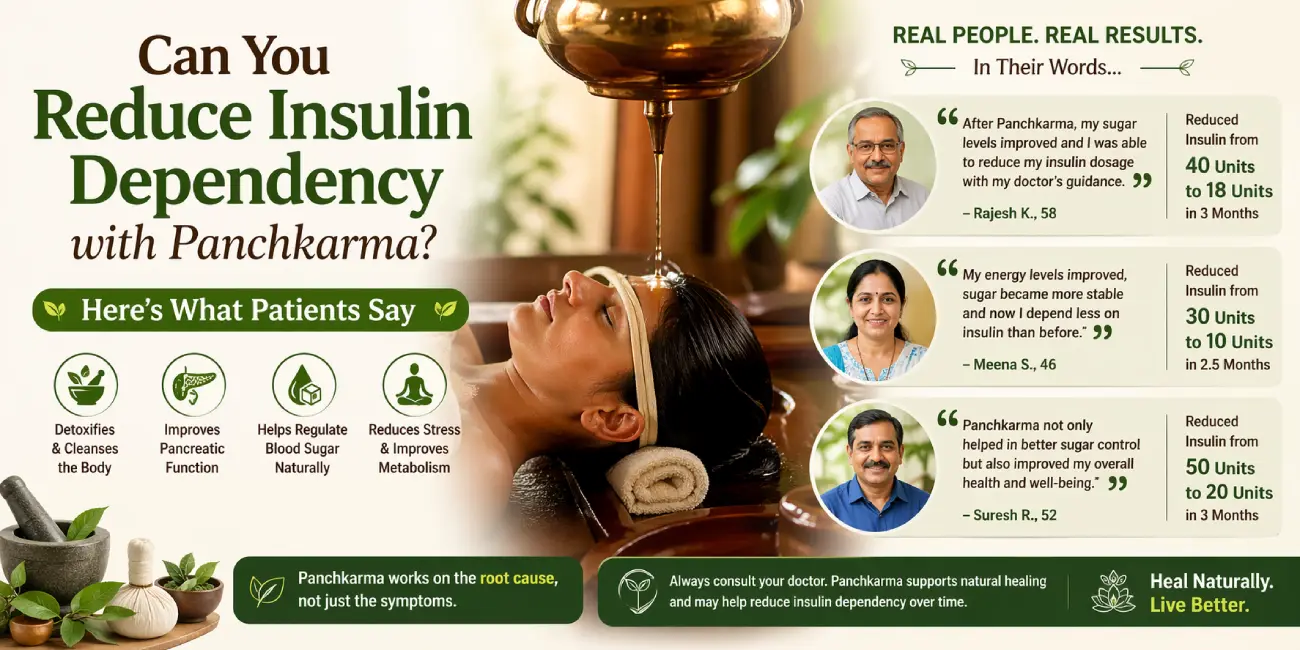
For millions of people living with Type 2 diabetes, the prospect of reducing — or even eliminating — dependence on insulin and oral medications is a profound hope. Modern medicine often presents diabetes as a progressive condition: one that inevitably leads to more medication, more complications, and more management.
At Ayush Panchkarma in the Himalayas of Palampur, we've observed many patients — over years of clinical practice — achieve meaningful improvements in their blood sugar control, energy levels, and medication requirements through authentic Panchkarma treatment, personalized Ayurvedic lifestyle programs, and dedicated practice.
But what if there's another way?
In this blog, we share the genuine experiences of patients who chose the Ayurvedic path — alongside an honest, medically responsible explanation of what Panchkarma can and cannot do for diabetes.
An Important Medical Disclaimer
Before we share patient experiences, we must be clear:
- Panchkarma is a complementary approach — it works alongside, not instead of, conventional medical treatment
- Never stop or reduce insulin or diabetes medications without the explicit guidance of your allopathic physician
- Panchkarma outcomes vary significantly between individuals based on type of diabetes, duration, lifestyle adherence, and other factors
- Type 1 diabetes (autoimmune) is fundamentally different from Type 2 and requires insulin for survival — Panchkarma can improve quality of life but cannot replace insulin in Type 1
With that said, here are genuine patient experiences from our center — shared with permission, with names changed for privacy.
Patient Story 1: Ramesh, 54, Chandigarh — Type 2 Diabetes for 8 Years
"When I first came to Ayush Panchkarma, I was on Metformin and Glipizide twice a day. My HbA1c was 9.2% and I had gained 18 kg over the past 6 years. My doctor had started discussing adding insulin to my regimen.
I spent 21 days at the center doing Virechana, Basti, Abhyanga, and Shirodhara. The first week was intense — my body felt like it was releasing something old. By the second week, my energy started coming back in a way I hadn't felt in years.
When I left, my fasting blood sugar had come down from 186 to 124. Six months later — after maintaining the diet and yoga they taught me — my HbA1c was 7.1% and my doctor reduced my Glipizide dose by half. I've lost 9 kg and I sleep like a teenager.
I haven't avoided insulin — but I've bought myself time and I feel like I'm fighting with the disease now, not surrendering to it."
Ramesh's case illustrates the most common trajectory: meaningful improvement in glycemic markers, weight, and energy — enabling a doctor-supervised reduction in oral medication dosage.
Patient Story 2: Sunita, 48, Delhi — Pre-Diabetes with Family History
"My mother has diabetes, my father has diabetes, and my doctor told me I was next. My fasting was 112 and post-meal was touching 165. He said if I didn't change things now, I'd be on medication within 2 years.
I came to the Himalayas for 14 days — partly for health, partly because I was burned out from my corporate job. The Shirodhara alone felt like it rewired my nervous system. The diet plan they gave me was something I could actually follow — not a punishment.
Ten months later: fasting is 94, post-meal is 128. I've maintained the morning yoga and the dietary changes. My doctor says I'm no longer pre-diabetic by clinical definition. I still get tested every 6 months, but for now — I'm free of it."
Sunita's case highlights the enormous potential of early intervention. Pre-diabetes and early Type 2 diabetes are significantly more responsive to Panchkarma and lifestyle change than advanced, long-standing diabetes.
Patient Story 3: Hardev Singh, 62, Punjab — Type 2 with Neuropathy
"I had been diabetic for 14 years. For the past 3 years, I have had neuropathy — burning, tingling feet that made it hard to sleep. I was on insulin (30 units/day), Metformin, and three other medications. My feet were the worst part.
I came for the neuropathy more than the blood sugar, honestly. They did Basti — the oil enema therapy — and specific foot treatments called Pada Abhyanga and Taila Dhara. After just 10 days, the nighttime burning had reduced by about 60%. By day 18, I could sleep through the night for the first time in years.
My blood sugar also improved — my endocrinologist reduced my insulin from 30 units to 18 units over 4 months, with careful monitoring. But honestly, the biggest gift was getting my sleep back. Sleep is everything when you're a diabetic — it was a vicious cycle of poor sleep and poor blood sugar, and Panchkarma broke that cycle."
Hardev's case highlights a crucial but underappreciated benefit: neuropathy management. Basti and specific nerve-nourishing Ayurvedic therapies can provide meaningful relief from diabetic neuropathy — improving quality of life even when blood sugar reduction is modest.
Patient Story 4: Meena, 39, Bangalore — Young-Onset Type 2 with Obesity
"I was diagnosed at 34 — young onset Type 2. I was 30 kg overweight and felt like my body had given up on me. The medications made me feel tired. I felt like I was 70 years old at 34.
I came to Ayush Panchkarma for three weeks. The combination of Virechana and the Kapha diet felt like my body finally had permission to detox. I lost 7 kg during the three weeks and another 8 in the following 4 months by following the diet.
My HbA1c went from 10.4% to 7.6% in 6 months. I'm still on one oral medication, but my doctor and I are discussing further reduction if I sustain this. More than numbers, I feel alive again. My skin cleared. I sleep well. My anxiety — which I hadn't even told my doctor about — almost disappeared."
Meena's experience illustrates how obesity, blood sugar, skin, mental health, and sleep are all interconnected in the Ayurvedic framework — and how addressing the root causes can create cascading improvements across all these dimensions simultaneously.
What the Science Says
While large-scale randomized controlled trials on Panchkarma specifically for diabetes are still limited, a growing body of research supports several mechanisms by which Ayurvedic interventions improve glycemic control:
- Virechana has been shown in small clinical studies to improve fasting blood glucose and post-prandial glucose levels, and to reduce oxidative stress markers
- Basti therapy has demonstrated improvements in lipid profiles and blood sugar in Type 2 diabetic patients in multiple pilot studies from Indian institutions
- Specific anti-diabetic herbs used in Ayurvedic treatment (Gurmar, Vijaysar, Fenugreek, Bitter Melon) have demonstrated insulin-sensitizing, glucose-lowering, and pancreatic-protective effects in multiple clinical trials
- Yoga and pranayama for diabetes have a stronger evidence base — multiple randomized trials have shown significant HbA1c reductions with consistent yoga practice
- Stress reduction through practices like Shirodhara and meditation directly lowers cortisol, which in turn reduces insulin resistance
This is not to claim Panchkarma as a "proven cure" — it is to say the mechanisms are scientifically plausible, individual results can be significant, and the safety profile (under proper medical supervision) is excellent.
Who Responds Best to Panchkarma for Diabetes?
Based on clinical observation, Panchkarma for Diabetes tends to be most effective for patients with:
- Type 2 diabetes (lifestyle-induced), especially with obesity
- Earlier stage of diabetes (under 10 years duration)
- Not yet on insulin, or on low insulin doses
- Motivated to make sustained lifestyle changes (diet, yoga, stress management)
- Younger age and better baseline health
- Active participation in the program (not passive — this requires engagement)
Patients who see more modest results tend to have:
- Long-standing diabetes (15+ years) with multiple complications
- High insulin dependency (50+ units/day)
- Significant kidney disease (which limits certain therapies)
- Poor compliance with dietary recommendations after the program
This is not to discourage older or more advanced patients from seeking help — many do experience meaningful quality-of-life improvements — but expectations should be set realistically.
The Role of Sustained Lifestyle Change
Every patient who achieved lasting results shared one common factor: they maintained the lifestyle changes taught during their program.
Panchkarma is a catalyst — it cleanses, resets, and rejuvenates. But the body will return to imbalance if the same causative factors (poor diet, sedentary lifestyle, chronic stress, poor sleep) are resumed.
The most successful patients follow what we call the Three-Month Integration Protocol after their residential stay:
- Month 1: Strict Kapha-pacifying diet, daily yoga (minimum 30 minutes), morning warm water rituals, early dinner
- Month 2: Continue diet, add Pranayama (Kapalbhati + Anulom Vilom) — 15 minutes daily, begin herbal supplement routine
- Month 3: Test and refine — work with your doctor to re-evaluate medication needs, sustain non-negotiable daily practices
The Himalayan environment of Palampur, Himachal Pradesh, provides patients with a uniquely supportive setting to begin this transformation — away from the noise and triggers of daily life.
A Word from Our Medical Team
"We never tell patients to stop their medications. That conversation belongs with their allopathic physicians. What we do tell them is this: your body has a remarkable capacity to heal and rebalance when given the right conditions. Panchkarma creates those conditions.
We have seen patients come in on 40 units of insulin and, after sustained work over many months, their doctors have reduced them to 10. We've seen HbA1c values drop from 11 to 6.8. We've seen neuropathy improve dramatically. We've seen people rediscover what it feels like to live in a healthy body.
These are not miracles. These are the results of an ancient, sophisticated system of medicine applied carefully, consistently, and with deep respect for each patient."
— Dr. Team, Ayush Panchkarma, Palampur
Take the First Step
If you are a diabetic patient — whether newly diagnosed, long-standing, or struggling with complications — and you are curious about what a personalized Panchkarma program could mean for you, we invite you to begin with a consultation.
Our experienced Ayurvedic physicians will assess your unique situation honestly, explain what to expect realistically, and design a program that works alongside your conventional treatment — not in conflict with it.
Your body remembers balance. Panchkarma helps it find the way back.