
Quick answer: Most people come to Panchakarma after trying other routes for months or years. They usually describe the first few days as tiring, the middle as the turning point, and the weeks after as the real test. Results vary by person, condition and how well they follow aftercare.
If you are reading this, you are probably where many of our patients were before they walked in. You've searched "does Panchakarma really work?", read polished brochures, and still can't tell what it's like to live through it.
So this post leaves out the brochure language. Below are six journeys that reflect the kinds of cases we see at Ayush Panchkarma, followed by what these journeys have in common, what Panchakarma can't do, and answers to the questions people ask most.
One honest note first. These stories are anonymized and written as composites, with names and details changed. They show typical patterns, not guaranteed outcomes. Your body, history and timeline will be your own.
What Panchakarma Actually Is (in Plain Words)
Panchakarma means "five actions." It's a set of cleansing procedures from classical Ayurveda, designed to remove accumulated toxins (ama) and bring the doshas (Vata, Pitta, Kapha) back toward balance.
It's a supervised process, not a spa weekend. A complete course normally includes three phases:
- Preparation: internal oils, gentle diet changes, and oil massage.
- The main cleansing procedures: chosen by your doctor after assessment.
- Recovery: a slow return to normal food and routine, which matters more than people expect.
If you want the full overview before reading the stories, our guide to Panchakarma treatment covers the basics.
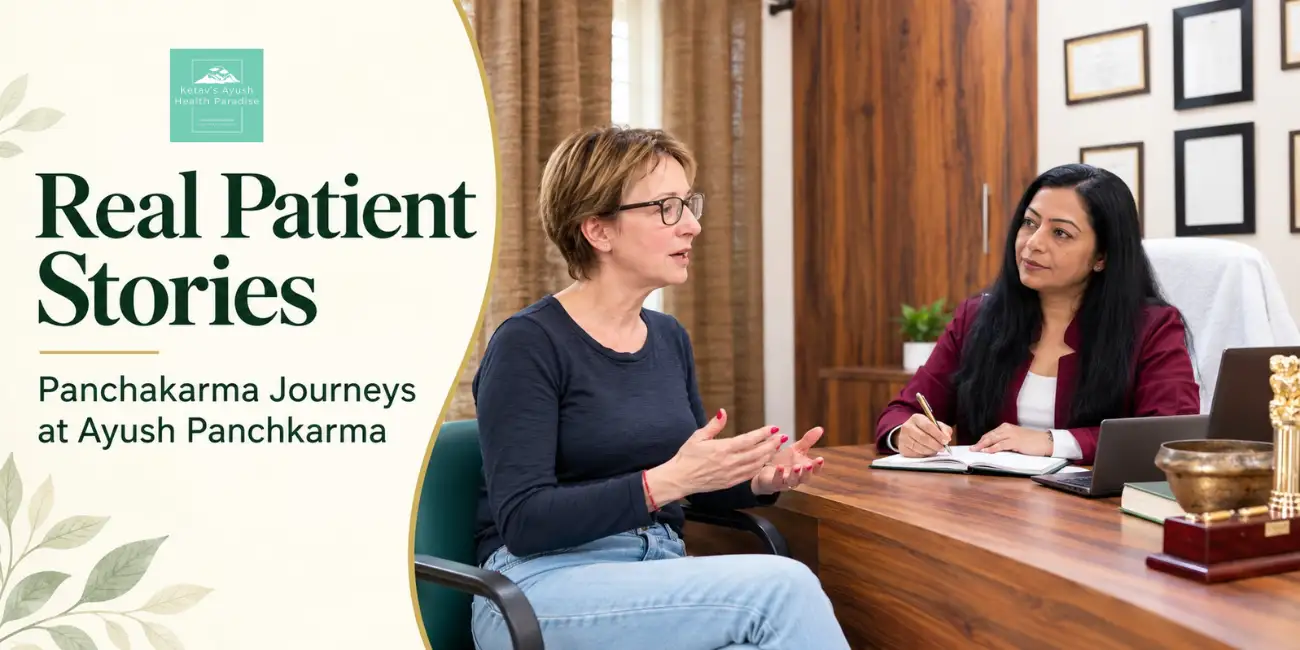
How Every Journey Starts: The Consultation
No two people here get the same plan. Before anything begins, you sit with a physician who looks at your pulse, tongue, digestion, sleep, stress, bowel habits, medical history and current medicines.
This is where the plan is decided, and it's also where some people are told Panchakarma isn't right for them yet. That's a good outcome, not a failure. If you're unsure where to begin, an Ayurvedic consultation with an experienced Ayurvedic doctor is the right first step.
Story 1: "I Couldn't Tie My Shoes Without Pain" (Chronic Lower Back Pain)
Profile: Male, 44, software team lead, Chandigarh region. Eleven years of desk work.
Rajan (name changed) arrived with lower back pain that spread to his left leg. He had tried physiotherapy, painkillers, and a brief round of injections. Each helped for a few weeks, then the pain returned.
His physician judged it to be a Vata-dominant condition with stiffness and dryness in the joints and tissues. The plan combined internal oleation, warm oil therapies and medicated enemas, a classic Panchakarma for back pain approach.
The first days were the hardest part. He felt sluggish and slightly irritable as his body adjusted to the preparation phase. "I thought, why am I paying to feel worse?" he said later.
The turning point came around day six, during the Basti therapy phase. He noticed he could sit through a full meal without shifting around. By day twelve he was walking in the morning without stopping to stretch.
Aftercare: He was given simple back-strengthening movements, a rule to stand every 45 minutes at work, and a lighter diet. Three months later, he reported far fewer flare-ups, though he still had some bad days when he skipped his routine.
Takeaway: Panchakarma gave him a window of relief. His daily habits decided how long that window stayed open.
Story 2: "My Skin Was Controlling My Social Life" (Psoriasis and Chronic Skin Flare-Ups)
Profile: Female, 31, school teacher, Ludhiana.
Meera (name changed) had patches of dry, scaly skin on her elbows and scalp for six years. Steroid creams cleared it temporarily. Then it came back, usually during stressful exam seasons.
Her physician looked beyond the skin. Digestion was irregular, sleep was poor, and she ate late at night. In Ayurvedic thinking, Ayurvedic treatment for psoriasis and other skin conditions often starts from blood impurity and Pitta-Kapha imbalance.
Her plan used a gentle purgation approach through Virechana therapy, with preparation beforehand and a careful diet afterward. For a few stubborn patches, her doctor discussed Raktamokshana (a blood-purification approach), which was done only after checking that she was suitable for it. Jalouka therapy (leech therapy) was very helpful for healing the skin patches and preventing scaling.
She found the cleansing days uncomfortable but manageable. Her skin looked slightly worse before it looked better, a pattern some patients describe, though it isn't guaranteed.
By week four, the redness had faded noticeably and scaling was reduced. She was told clearly that psoriasis is a long-term condition and that Panchakarma is one part of managing it, not a switch that turns it off.
Takeaway: For chronic skin issues, expect improvement and better control, not instant disappearance.
Story 3: "I Was Tired of Planning My Day Around a Toilet" (Digestive Problems and IBS-Type Symptoms)
Profile: Male, 38, sales manager, Mohali.
Amit (name changed) had bloating, irregular stools, acidity and constant fatigue. Tests showed nothing alarming. "Everyone told me it's stress," he said. "That didn't help me eat lunch."
Ayurveda treats digestive fire (agni) as the foundation of health. His physician saw weak agni with ama buildup, worsened by skipped meals and heavy dinners, which is why Panchakarma for IBS and gut problems starts with digestion, not drastic cleansing.
His treatment was one of the gentlest we offer. It focused on diet correction (free from dairy and gluten), mild herbal support, oil massage and sweating therapy. Gentle Abhyanga massage and Nabhi Basti therapy played a major role, calming his nervous system alongside his gut.
Within the first week he noticed that his appetite felt "normal" again, meaning hungry at mealtimes and not at 11 p.m. Bloating dropped over the next two weeks.
Takeaway: Digestive cases often respond to the quiet parts of the program, such as routine, warm food and rest, more than to dramatic procedures.
Story 4: "I Hadn't Slept Properly in Two Years" (Stress, Anxiety and Insomnia)
Profile: Female, 47, business owner, Delhi NCR.
Sunita (name changed) ran a small manufacturing unit. After a difficult year, she was waking at 3 a.m. with a racing mind. Sleeping pills made her groggy, and she didn't want to depend on them.
Her physician identified aggravated Vata and Pitta in the mind and nervous system. Her plan, a form of Panchakarma for insomnia and stress, leaned on calming therapies, including Shirodhara, where a thin stream of warm oil flows over the forehead, along with Nasya therapy and a strict, boring daily rhythm.
That last part surprised her. Fixed meal times, no phone after 8:30 p.m., early lights-out. "The treatments were lovely," she said, "but the routine is what changed my nights."
By the second week she was sleeping five to six unbroken hours, up from two or three. She describes her anxiety as "lower volume," not gone.
Takeaway: Panchakarma can support stress recovery. It doesn't replace psychiatric care when that's needed, and our doctors say so openly.
Story 5: "My Periods Were a Mystery" (PCOS and Irregular Cycles)
Profile: Female, 27, MBA student, Patiala.
Priya (name changed) had irregular periods, weight gain and acne. She'd been told to "lose weight and come back." She wanted a structured approach alongside medical follow-up.
Her physician found a Kapha-dominant pattern with sluggish metabolism. Her plan, Ayurvedic treatment for PCOS, used a warming diet, herbal support, detoxifying therapies and a movement routine. She continued her gynecologist's monitoring in parallel, which we always encourage.
The results developed slowly. Her first period after treatment came a few weeks earlier than usual, which encouraged her, but real change took about three months of consistent habits.
Takeaway: Hormonal conditions need patience. Anyone promising a quick PCOS fix is not being straight with you.
Story 6: "I Just Wanted to Climb Stairs Again" (Joint Stiffness and Arthritis)
Profile: Male, 62, retired bank officer, Amritsar.
Gurmeet (name changed) had knee and hand stiffness, worse in winter. Mornings were the hardest. He feared surgery and wanted to delay it as long as possible.
His physician considered his age, strength and medicines carefully and adjusted the intensity downward. Instead of aggressive cleansing, he received a milder plan for arthritis treatment in Ayurveda with warm oil therapies: Jahnu Basti, Upnaha therapy, Nadi Sweda, and supportive herbs.
He felt looser by the second week. He later said the most meaningful change was walking to the gurdwara without his stick on good days.
Takeaway: Older patients are not excluded from Panchakarma. Their plans are simply gentler and slower.
What These Six Journeys Have in Common
Looking across hundreds of cases, patterns show up again and again:
- Day 1 to 3 is rarely the best part. Fatigue, low mood or a sense of "nothing is happening" is common as preparation begins.
- The turning point is usually in week one or two. Sleep, appetite or pain tends to shift first.
- Aftercare decides the long run. Patients who followed diet and routine guidance kept their gains much longer.
- Expectations matter. People who came hoping for "everything gone" were more disappointed than those who aimed for "much better."
- Doctors adapt plans daily. What happened to Rajan on day six might happen to someone else on day nine.
What Panchakarma Can't Do
This section is the one other clinics often skip.
- It doesn't cure every condition.
- It isn't a substitute for emergency or surgical care.
- It's not suitable for everyone, especially during pregnancy, severe weakness, certain heart conditions or acute infections without clearance.
- It won't undo years of poor habits without you changing them.
- If you take regular medicines for diabetes, blood pressure or thyroid, tell your physician. Never stop prescribed medication on your own.
How to Prepare for Your Own Journey
- Book an appointment before committing to a package.
- Reduce caffeine and junk food about a week before.
- Arrange time off. Rest is part of the treatment.
- Bring your reports, including blood tests and scans.
- Set realistic goals, such as "better sleep" or "less pain," not "perfect health."
What a Typical Day Looks Like
Mornings start with herbal drinks or prescribed internal medicine. Then comes the yoga / meditation session, then after 1 hour of breakfast, the morning session of treatment as per the individual treatment plan. Lunch is simple, warm and freshly cooked. Afternoons are for rest, followed by evening sessions of therapies, not scrolling or working. Late evening relaxation time leads to early dinner and early bedtime.
It may sound dull, but that's the point. The body can only repair when it's not constantly stimulated.
Frequently Asked Questions About Panchakarma Experiences
Does Panchakarma really work?
For many people it helps with pain, digestion, stress and skin concerns, particularly when combined with lifestyle changes. Evidence is stronger for some conditions than others, and research is ongoing. It works best as part of a long-term plan.
How long does a Panchakarma course take?
Typically 7, 14 or 21 days depending on the condition and your strength. Some patients need repeat courses. You can compare durations in our Panchakarma packages.
Is Panchakarma painful?
Most therapies are soothing. Some procedures, like cleansing therapies, can cause temporary discomfort or fatigue. Your doctor monitors you throughout.
What are the side effects of Panchakarma?
Temporary tiredness, mild headache, loose stools or low appetite can occur. Serious effects are rare under proper supervision. Tell the doctor if anything feels wrong.
How soon will I see results?
Some people notice changes in sleep or digestion within a week. Chronic conditions usually take weeks to months.
Can I work during Panchakarma?
Light desk work is sometimes possible with mild plans, but rest is strongly recommended for best results.
Is Panchakarma safe for older adults?
Yes, with modified, gentler plans after a proper assessment.
Can I do Panchakarma at home?
Not safely for the main cleansing procedures. They need trained supervision and monitoring.
How do I know if the clinic is genuine?
Check the doctors' registered Ayurvedic qualifications (BAMS or MD Ayurveda), ask for a written plan, and make sure the clinic does an individual assessment. You can read more about our team and approach.
How much does Panchakarma cost in India?
The Panchakarma cost in India varies widely by duration, therapies and location. Ask for a transparent breakdown before you start.
The Bottom Line
Panchakarma journeys aren't straight lines. They involve uncomfortable days, small wins, and a lot of patience. The people who benefit most are usually the ones who treat the course as the start of a new routine, not a one-time fix.
If you'd like to talk through your own situation, you can book an appointment and ask the questions you've been holding back. We'd rather you decide with full information than sign up on hope alone.
Disclaimer: This article is for general education and does not replace professional medical advice. Individual results vary.