
By the clinical team at Ketav's Ayush Health Paradise, Palampur · Reviewed by Vaidya Dr Seema Santoshi, BAMS.YFC. CGO. PGDPSM] Updated October 2026
By the clinical team at Ketav's Ayush Health Paradise, Palampur · Reviewed by Vaidya Dr Seema Santoshi, BAMS.YFC. CGO. PGDPSM · Updated October 2026
The short answer
Panchakarma for stress and anxiety is a retreat-style programme that combines calming oil therapies (such as shirodhara and head massage), gentle detox, nourishing diet, yoga, breathing practices and a break from screens. At a retreat in Palampur, programmes usually run 7 to 21 days. Many people report better sleep, a calmer mind and less physical tension afterwards. It is a complementary approach: it is not a substitute for therapy or medicines when you have an anxiety disorder, and it works best when it is paired with habits you can keep up at home.
Key takeaways
- Stress and anxiety are not the same thing. Everyday stress responds well to rest and routine. An anxiety disorder is a medical condition that deserves professional assessment.
- Ayurveda links anxiety mainly with aggravated vata, the dry, mobile, airy tendency, and with an overworked mind.
- The signature Ayurvedic therapies are shirodhara, shiro abhyanga, nasya and basti, plus yoga, pranayama and meditation.
- Evidence is encouraging but limited for Ayurvedic therapies. It is stronger for yoga, mindful breathing and meditation.
- Do not stop antidepressants, anti-anxiety medicines or sleeping tablets without your doctor.
- If you are having thoughts of harming yourself, please seek help straight away. Details are in the safety section below.
What is the difference between stress and anxiety?
People use the words interchangeably, but they differ.
Stress is your body's response to a demand or pressure, like a deadline, a family problem or a move. It usually eases when the demand passes.
Anxiety is a persistent feeling of worry or fear that can continue even when there is no clear threat. When it is intense, lasts for weeks or months, and interferes with daily life, it may be an anxiety disorder, such as generalised anxiety, panic disorder or social anxiety.
| Everyday stress | Anxiety disorder | |
|---|---|---|
| Trigger | Clear, external | Often unclear or out of proportion |
| Duration | Passes when the situation does | Persists for weeks or months |
| Body signs | Tension, tiredness, headache | Racing heart, breathlessness, trembling, stomach upset, insomnia |
| Effect on life | Manageable | Interferes with work, relationships, sleep |
| Best first step | Rest, routine, support | Medical or psychological assessment |
The same retreat can help with both, but you should know which one you are dealing with.
What are the common signs of stress and anxiety?
- Difficulty falling or staying asleep
- Constant worry and trouble switching off
- Tight shoulders, jaw clenching, headaches
- Fast heartbeat or chest tightness
- Digestive upset, loss of appetite or comfort eating
- Irritability, low patience, crying easily
- Poor concentration and forgetfulness
- Feeling 'wired but tired'
Some of these overlap with thyroid problems, anaemia, vitamin deficiencies, heart rhythm issues and depression. If your symptoms are new or severe, see a doctor and get basic tests first.
How does Ayurveda explain stress and anxiety?
Ayurveda looks at the mind and body together. Three ideas matter here.
The three gunas of the mind. Sattva is clarity and calm. Rajas is restlessness and drive. Tamas is heaviness and dullness. In chronic stress, rajas rises and sattva falls.
Vata imbalance. Vata governs movement, including the nerves and the flow of thoughts. When it is aggravated by irregular routines, skipped meals, travel, late nights and overthinking, you feel scattered, anxious and light-sleeping.
Agni and digestion. Weak digestion is seen as both a cause and an effect of stress. Many anxious people have a gut that tightens or races.
In modern language, this lines up loosely with what we know about the stress response, the gut-brain connection and the link between poor sleep and anxiety. The Ayurvedic framework is a way of organising treatment, and it is not a laboratory diagnosis.
Which Panchakarma therapies are used for stress and anxiety?
Panchakarma programmes for the mind are usually gentler than those for joint or digestive disease. Heavy cleansing is often kept light, because a depleted, anxious person needs nourishment first.
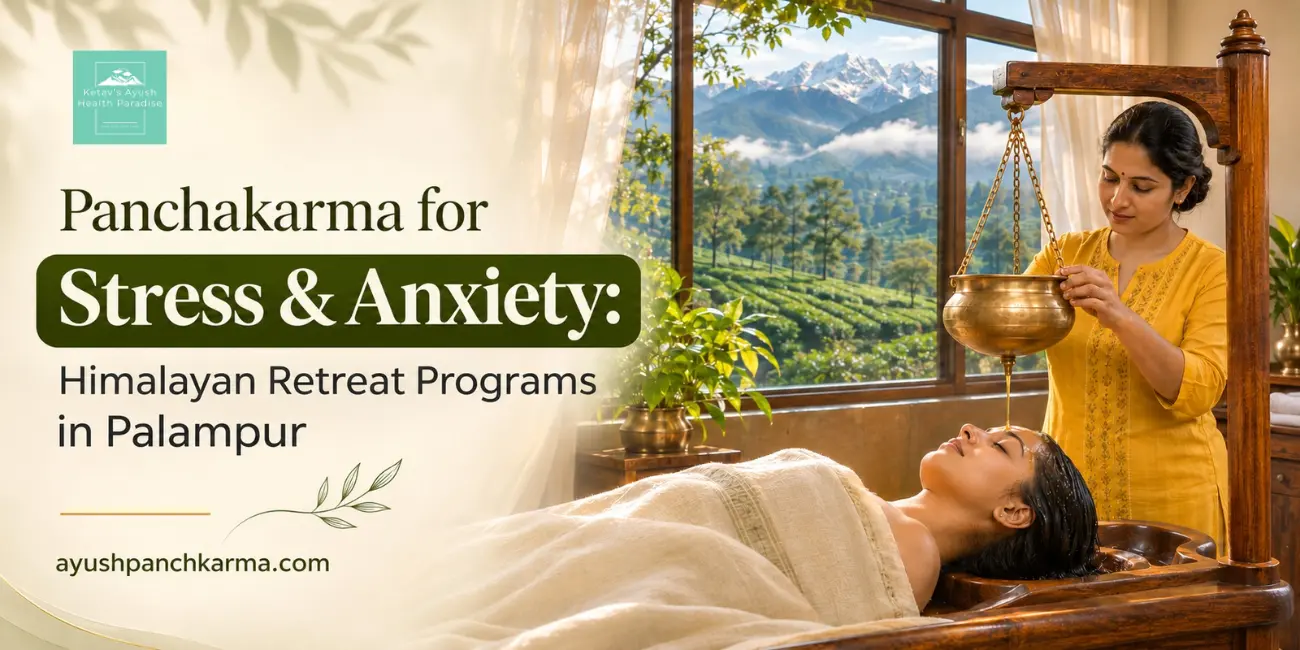
Shirodhara
A thin, steady stream of warm herbal oil, or sometimes buttermilk or milk decoction, flows over the forehead for 30 to 45 minutes while you lie still. Most people find it deeply relaxing, and a good number fall asleep. Research is small but shows reductions in stress scores and improvements in sleep and relaxation markers in some studies. It is often done for 7 to 14 consecutive days.
Shiro abhyanga and head, neck and shoulder massage
A firm but soothing scalp and neck massage with warm oil. It releases tight muscles, which many people carry in the neck and jaw. If your stress shows up as stiffness, the overlap with tension-driven neck and back pain is worth reading about.
Abhyanga and swedana
A full-body oil massage followed by gentle steam. Touch therapy, warmth and slow breathing together calm the nervous system.
Shiro basti
Warm oil is held in a leather cap on the head for 20 to 45 minutes. It is used for chronic insomnia and heavy mental fatigue and is a more intensive therapy than shirodhara. It requires skilled supervision.
Nasya
A few drops of medicated oil, such as Anu taila, are put in the nostrils after a facial massage and steam. It is traditionally used for head and mental conditions, and it is also used for sinus problems and headaches.
Takradhara
Medicated buttermilk is poured over the forehead. It has a cooling effect and is sometimes preferred when stress shows up as heat, irritability and skin flare-ups.
Basti (medicated enema)
Basti is seen as the main treatment for vata. A mild oil-based course may be offered for people with chronic anxiety, constipation and poor sleep. It is not essential and many programmes skip it.
Virechana and vamana
Strong purgation or vomiting (virechana and vamana) is rarely used for anxiety and is usually avoided in people who are underweight, exhausted or sleep-deprived. If an anxiety programme includes them, ask the physician why.
What else is in a Himalayan retreat programme?
The oil therapies are only part of the picture. Many of the benefits probably come from the rest of the day.
- Yoga: slow, grounded sequences, not athletic ones. Evidence for yoga in reducing anxiety and stress is among the stronger in this field.
- Pranayama: alternate-nostril breathing (nadi shodhana), slow exhalation breathing and humming breath (bhramari) activate the body's relaxation response.
- Meditation and yoga nidra: guided practices for sleep and settling an overactive mind.
- Digital detox: phones are reduced or kept off for most of the day.
- Nature time: walks through pine and deodar forest, tea gardens or along streams.
- Counselling or reflective journaling: some centres add these. They help when anxiety has a story behind it.
- Sleep routine: fixed sleep and wake times.
What does a sample 7-day stress-reset programme look like?
| Day | Focus | Typical elements |
|---|---|---|
| 1 | Arrival and assessment | Consultation, pulse and history, light diet, rest, short walk |
| 2–3 | Settling | Daily abhyanga and swedana, yoga, pranayama, early nights |
| 4–6 | Deep calm | Shirodhara each day, head and neck massage, yoga nidra, nature walks |
| 7 | Integration | Light massage, review, home-care plan |
A 14-day Panchakarma package extends the same arc and may add nasya or a mild basti course. A 21-day stay is used for long-standing sleeplessness or burnout.
People new to this style of stay can read this day-by-day walkthrough for beginners to know what to expect from the daily rhythm.
What is a typical day on a stress retreat?
- 6:30 am: Wake up, warm water, gentle stretching
- 7:30 am: Yoga and pranayama
- 8:30 am: Light breakfast, such as porridge, stewed fruit and herbal tea
- 10:00 am: Shirodhara or massage
- 12:30 pm: Lunch, warm and simple
- 2:00 pm: Rest, reading or a quiet walk
- 4:30 pm: Meditation or yoga nidra
- 6:30 pm: Light supper
- 8:00 pm: Screen-free wind-down, journaling or soft music
- 9:30 pm: Lights out
The structure is the point. Anxious minds tend to be calmer when the day is predictable.
What about food and drink for anxiety?
Ayurveda suggests a Panchakarma diet of foods that are warm, moist, grounding and easy to digest for people with vata-type anxiety.
Often encouraged
- Warm porridge, khichdi, soft rice
- Cooked vegetables, soups and stews
- Ghee in moderation
- Stewed apples and pears, soaked almonds
- Warm milk with a pinch of nutmeg at night, if tolerated
- Herbal teas such as cumin-coriander-fennel, tulsi or chamomile
Often reduced
- Coffee, strong tea, energy drinks
- Alcohol and nicotine
- Very spicy, dry or fried snacks
- Cold, raw or leftover food
- Skipping meals
- Heavy late-night eating
Modern research agrees on some of this. Caffeine can worsen anxiety and sleep, alcohol disturbs sleep, and regular meals help steady mood and energy. If you want to know how emotional eating and cortisol interact with weight, see this explanation of stress-linked weight gain.
Which herbs are used, and are they safe?
Ayurvedic practitioners often prescribe herbs alongside therapy. Common examples include:
- Ashwagandha (Withania somnifera): several small randomised trials suggest it may reduce stress and anxiety scores. It can affect thyroid hormone levels, may cause drowsiness or stomach upset, and is generally avoided in pregnancy.
- Brahmi (Bacopa monnieri): traditionally used for memory and calm. It may cause stomach upset and slow the heart rate in some people.
- Jatamansi (Nardostachys jatamansi): traditionally used for sleep and nervous tension.
- Shankhpushpi, mandukaparni: used as nervine tonics.
Herbs are not automatically safe because they are natural. They can interact with sedatives, antidepressants, thyroid medicines, blood pressure drugs and diabetes medicines. Always tell your Vaidya and your doctor every medicine and supplement you take.
What does the research actually say?
- Yoga, mindful breathing and meditation have the strongest evidence among the components of a retreat for reducing anxiety and stress symptoms.
- Shirodhara has small studies showing relaxation, lower stress scores and better sleep in some participants. Study quality varies.
- Ashwagandha has several small trials, though most are short and use different doses and preparations.
- Panchakarma as a whole has limited controlled research for anxiety disorders. Part of its benefit may come from rest, routine, nature, touch and attention, which are valuable in their own right.
In plain terms: it is reasonable to expect relaxation, better sleep and a sense of reset. It is not reasonable to expect a guaranteed cure for an anxiety disorder.
Can Panchakarma replace therapy or medicine?
No. If you have been diagnosed with an anxiety disorder, panic disorder, depression or another condition:
- Continue your prescribed medicines until your psychiatrist or physician advises otherwise. Stopping suddenly can cause withdrawal symptoms or relapse.
- Consider cognitive behavioural therapy (CBT) and other psychological treatments, which have strong evidence.
- Tell the retreat doctor about your diagnosis, medicines and any history of panic attacks or self-harm.
- Treat the retreat as a supportive addition, and plan follow-up with your own mental-health professional afterwards.
When should you seek urgent help?
Please do not wait for a retreat if you have any of these:
- Thoughts of ending your life or harming yourself
- Panic attacks that do not settle or come with chest pain or fainting
- Hallucinations, confusion or loss of touch with reality
- Severe inability to eat, sleep or function for more than a couple of weeks
- Heavy alcohol or drug use to cope
In India, you can call Tele-MANAS at 14416 (or 1-800-891-4416), a free, 24-hour government mental-health helpline, or go to your nearest hospital emergency department. If you are with someone who is in danger, call emergency services at 112.
Who is likely to benefit from a retreat?
People who often report good results include those with:
- Work-related burnout and chronic stress
- Sleep difficulty linked to overthinking
- Muscle tension, tension headaches and jaw clenching
- Mild to moderate anxiety, with a doctor's awareness
- Stress-related digestive upset
- A need to reset habits, with the commitment to follow through
Some people need an extra layer of care, or a different route, including those with:
- Severe depression or a history of suicidal thoughts (treat with specialist care first)
- Active psychosis, bipolar disorder or substance dependence (need psychiatric supervision)
- Pregnancy
- Serious heart, kidney or liver disease
- Acute infection or high fever
Does stress affect skin and joints too?
Often, yes. Stress hormones can trigger or worsen skin conditions and inflammatory joint problems. If you notice flare-ups when you are under pressure, read about stress flares in psoriasis and eczema and about inflammatory joint conditions to see how a combined approach is planned.
Why do people choose a Himalayan retreat in Palampur?
Palampur sits at around 1,200 metres in the Kangra Valley, below the snow-capped Dhauladhar range. There are three reasons it suits a stress programme.
- Distance from noise and notifications. It is quiet, and mobile coverage is sometimes patchy, which makes switching off easier.
- Nature close by. Tea gardens, pine and deodar forest and open mountain views are a short walk away.
- Accessibility. It is reachable by road from Chandigarh, Mohali and Pathankot, and by air through Gaggal (Kangra). That keeps the journey manageable.
Spring (March to May) and autumn (September to November) are the most comfortable seasons. Monsoon brings heavy rain and winters can be cold, so check the room facilities. Longer programmes include an on-site homestay with Ayurvedic meals.
How do you prepare for a stress retreat?
- Reduce coffee and alcohol for a week before you come.
- Tell your workplace you will be offline and set an out-of-office.
- Bring any medical reports and a list of medicines.
- Pack loose cotton clothes, a shawl, walking shoes and a notebook.
- Leave work devices behind if you can.
- Arrive with realistic expectations. You will feel quiet and perhaps a little emotional.
What happens when the retreat ends?
The most common reason benefits fade is going straight back to the old routine. Try to keep a few anchors:
- Fixed sleep and wake times, including weekends.
- Ten to twenty minutes of breathing or meditation each morning.
- Warm oil head and foot massage twice a week before bedtime.
- A regular lunch break away from the screen.
- A limit on caffeine, ideally none after noon.
- A weekly walk outdoors.
- A follow-up with your Vaidya or doctor after 4 to 6 weeks.
How to choose a retreat
- Check that a qualified Ayurvedic physician (BAMS or MD Ayurveda) examines you personally.
- Ask how the programme is tailored to you.
- Ask whether mental-health history is reviewed and how emergencies are handled.
- Look for transparent pricing and a clear list of what is included.
- Be cautious of any retreat that promises to 'cure anxiety', asks you to stop medicines, or sells the same package to everyone.
Frequently asked questions
Can Panchakarma help with anxiety?
It may help some people feel calmer, sleep better and carry less physical tension, especially when combined with yoga, breathing and lifestyle change. It does not cure anxiety disorders and should be used alongside proper medical care.
What is shirodhara and what does it do?
Shirodhara is a therapy in which warm medicated oil flows steadily over the forehead. It is used for relaxation, sleep difficulty and mental tension. Small studies suggest it reduces stress and improves relaxation, but larger trials are needed.
How long should a stress retreat be?
Seven days is enough for a reset. Fourteen days works better for chronic stress or poor sleep. Twenty-one days is used for burnout or long-standing conditions.
Is Panchakarma safe if I take antidepressants?
Often yes, but you must tell the physician. Some herbs can interact with antidepressants and sedatives. Never stop your medicine to join a programme.
Does Panchakarma work for insomnia?
Many people report better sleep after shirodhara, evening routines and a screen-free stay. Persistent insomnia should still be assessed for causes such as sleep apnoea, thyroid issues or depression.
Will I be able to use my phone?
Usually only in a limited window. The digital break is part of the benefit.
Is a retreat suitable for panic attacks?
It may help calm daily tension, but panic disorder needs medical assessment and often psychological therapy. Tell the physician about your attacks before booking.
What should I avoid during the retreat?
Coffee, alcohol, late nights, heavy food and constant phone use. Your Vaidya will give a personalised list.
Can I come alone?
Yes. Many guests come alone, and the structured day and group meals mean you are not isolated.
What is the best time of year for a stress retreat in Palampur?
Spring and autumn are the most comfortable and popular.
How soon will I feel a difference?
Many people notice better sleep and less tension within 3 to 5 days. Deeper changes take longer and need to be maintained at home.
Choosing a Himalayan stress-relief retreat in Palampur
People searching for a Himalayan wellness retreat in Palampur usually want three things: a qualified physician, a calm setting and a plan that is personal. Ask whether shirodhara treatment in Palampur is included and how many sessions are planned. If you want Ayurvedic stress relief treatment in a longer format, ask about 14- and 21-day options.
If your stress shows up elsewhere in the body, these may help:
- Joint pain made worse by tension: Ayurvedic therapy for arthritis pain
- Skin flares during busy or anxious periods: Panchakarma for psoriasis and eczema treatment
Plan your stress and anxiety retreat
If you are exhausted, wired and ready for a proper reset, start with a free consultation. At Ketav's Ayush Health Paradise in Palampur, the first consultation looks at your history, sleep, stress triggers and current medicines, and then recommends a programme length that fits your needs and budget.
Call +91 88943 56919, email info@ayushpanchkarma.com or book a consultation online.
Medical disclaimer: This article is for general education and does not replace professional mental-health care. If you feel unable to cope, or are thinking about harming yourself, contact a doctor or a helpline such as Tele-MANAS (14416) immediately. Do not stop prescribed medication without your doctor's guidance.